Your order page shows “pending” while the warehouse already shipped it. So you add usePoll(5000), and now a thousand open tabs ask the server every five seconds for news that comes twice a day. Inertia 3.11 has a better deal: mark the prop as live, broadcast an event when it changes, and only the pages that care reload it.
TL;DR
- inertia-laravel 3.7.0 adds
Inertia::live($value, on: $event). The page gets the channels and event names, and the client reloads that one prop (a partial reload) when the event is broadcast. - @inertiajs/vue3 3.11.0 adds the
liveoption tocreateInertiaApp(). Passecho()from@inertiajs/vue3/echoand you’re done.pusher(),actionCable()and custom transports exist too. - Events can carry the new value with
Inertia::broadcastProps(), so no request is made at all. Reloads are throttled (1 s per prop by default) and paused while the tab is hidden. - From our lab:
toOthers()only works if the event usesInteractsWithSockets, a signal-only event still broadcasts the whole model unless you addbroadcastWith(), and a bare channel string is always public.
What’s new at a glance#
| Package | Version | Released (UTC) | What changed |
|---|---|---|---|
inertiajs/inertia-laravel | 3.7.0 | Nov 2, 2026 10:45 | Inertia::live(), ->live() on defer/once/optional/always props, Inertia::broadcastProps() |
@inertiajs/vue3 (and React, Svelte, core) | 3.11.0 | Nov 2, 2026 11:40 | live option, echo() / pusher() / actionCable() transports, useProp(), live router event, X-Socket-Id header |
That’s the whole release: PR #3232 on the client, PR #901 on the server, plus a dependency bump (#3368). No breaking changes: @laravel/echo-vue is an optional peer dependency, so apps without live props install nothing new.
Live props in one paragraph#
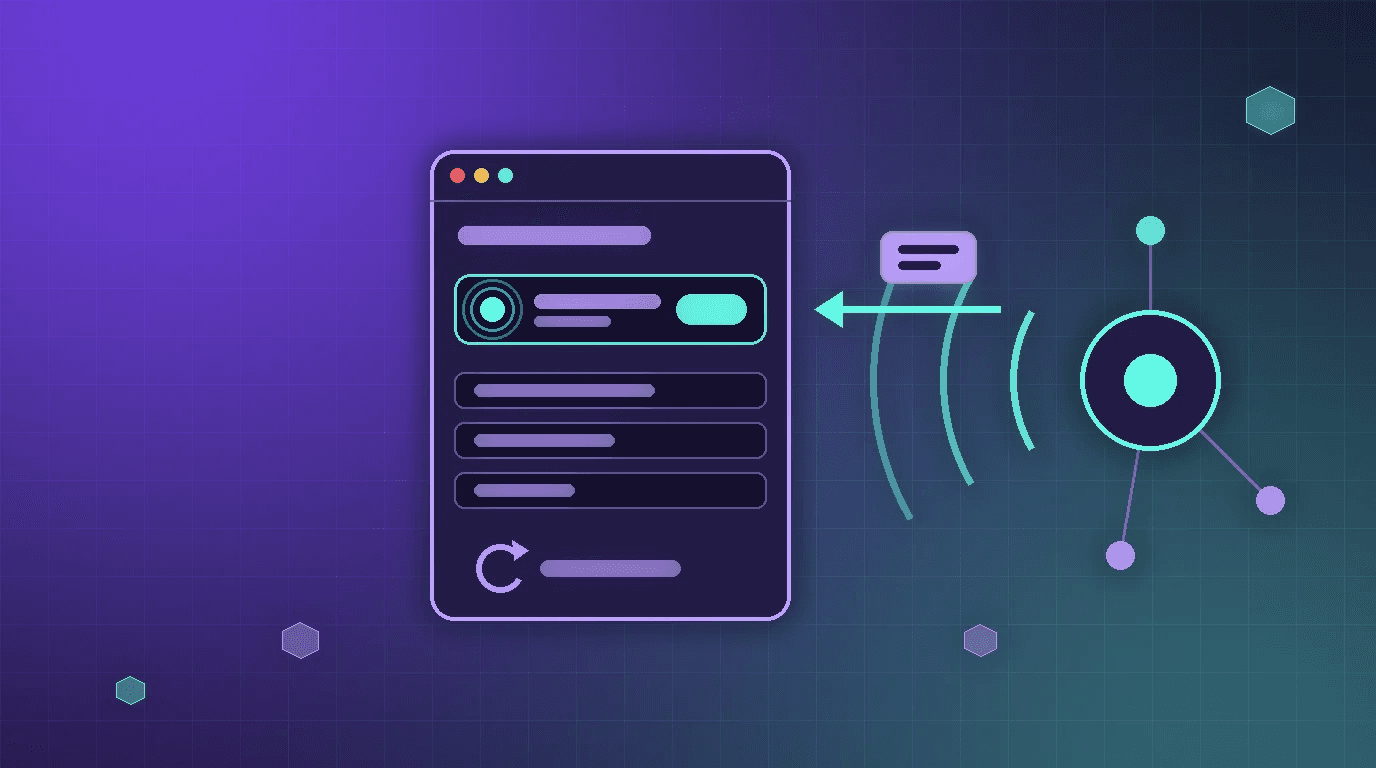
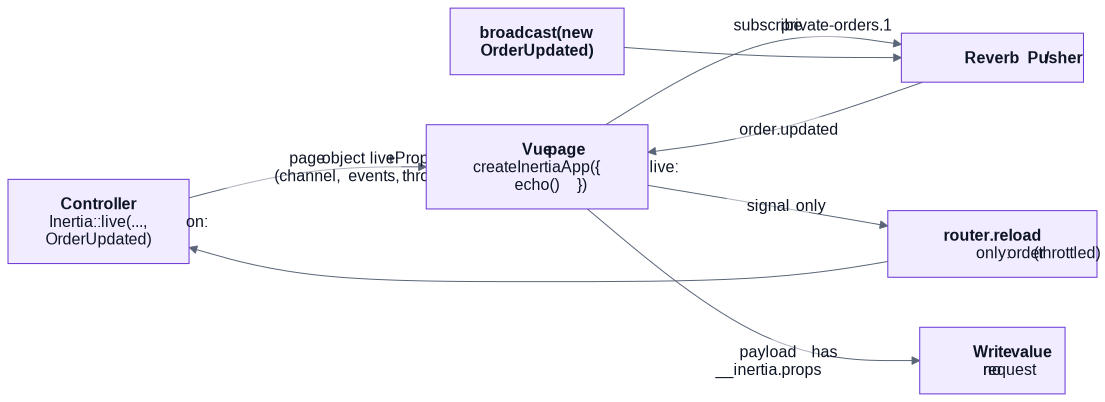
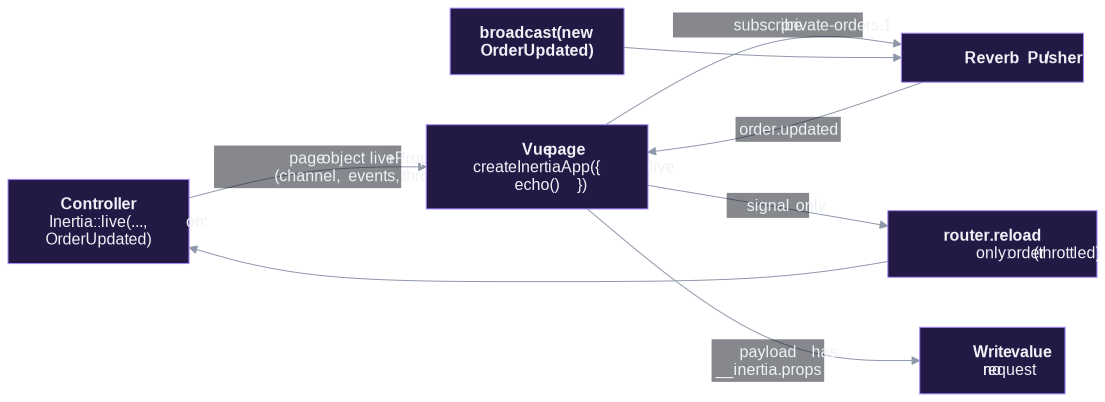
A live prop is a normal page prop with a list of broadcast events attached. The server puts the channels and event names in a new liveProps key of the page object. The client subscribes to them through a transport (Laravel Echo, for most of us), and when an event arrives it runs router.reload({ only: ['order'] }) for you. If the event already contains the new value, the client writes it into the page and skips the request.
Server side: Inertia::live()#
Start with a broadcast event you probably already have. Two details matter for live props, and both come from our lab (more on that below): InteractsWithSockets, and a small broadcastWith().
namespace App\Events;

use App\Models\Order;
use Illuminate\Broadcasting\InteractsWithSockets;
use Illuminate\Broadcasting\PrivateChannel;
use Illuminate\Contracts\Broadcasting\ShouldBroadcast;

class OrderUpdated implements ShouldBroadcast
{
    use InteractsWithSockets; // needed for ->toOthers()

    public function __construct(public Order $order) {}

    public function broadcastOn(): PrivateChannel
    {
        return new PrivateChannel("orders.{$this->order->id}");
    }

    public function broadcastAs(): string
    {
        return 'order.updated';
    }

    // A signal only. Without this, the whole public $order model is broadcast.
    public function broadcastWith(): array
    {
        return ['order_id' => $this->order->id];
    }
}
Then mark the prop as live and pass the event. Inertia reads the channels from broadcastOn() and the name from broadcastAs() (or the class name when there is none), so you don’t repeat them:
3.10: poll the whole page, then 3.11: a live prop:
public function show(Order $order): Response
{
    return Inertia::render('orders/show', [
        'order' => fn () => OrderResource::make($order->fresh()),
    ]);
}

// orders/show.vue: usePoll(5000, { only: ['order'] })public function show(Order $order): Response
{
return Inertia::render('orders/show', [
'order' => Inertia::live(
fn () => OrderResource::make($order->fresh()),
on: new OrderUpdated($order),
),
]);
}Wherever the order changes, broadcast as usual:
public function update(UpdateOrderRequest $request, Order $order): RedirectResponse
{
    $order->update($request->validated());

    broadcast(new OrderUpdated($order))->toOthers();

    return back();
}
This is what the page object carried in our lab. Channel names come without Laravel’s private- prefix, with the type next to them, so each transport can add its own prefix:
"liveProps": {
  "order": {
    "listeners": [
      { "channel": { "name": "orders.1", "type": "private" }, "events": ["order.updated"] }
    ]
  }
}
More events, other channels, other prop types#
return Inertia::render('orders/show', [
    // several events: each one brings its own channels
    'order' => Inertia::live(fn () => OrderResource::make($order->fresh()), on: [
        new OrderUpdated($order),
        new OrderShipped($order),
    ]),

    // deferred on the first load, live after that
    'activity' => Inertia::defer(fn () => $order->activity()->latest()->get())
        ->live(on: new OrderUpdated($order)),

    // a class name works when channels and name don't need the payload
    'stats' => Inertia::live(fn () => ['orders' => Order::count()], on: StatsUpdated::class, throttle: 4000),

    // listen on a channel you choose
    'feed' => Inertia::live(fn () => Feed::latest(), on: 'feed.updated', channel: new PrivateChannel('team.7')),
]);
->live() also works on Inertia::once(), Inertia::optional() and Inertia::always(). An optional live prop is only refreshed after the page has loaded it. Merge props can’t be live: Inertia::defer(...)->merge()->live(...) throws a LogicException, and Inertia::merge() has no live() method at all.
Private, presence and encrypted private channels are authorized in routes/channels.php, the same as anywhere else:
Broadcast::channel('orders.{order}', fn (User $user, Order $order) => $user->id === $order->user_id);Client side: one option in createInertiaApp#
Install the Echo packages (we used @laravel/echo-vue 2.6.3 with Reverb):
npm install @inertiajs/vue3@^3.11 @laravel/echo-vue laravel-echo pusher-js3.10, then 3.11:
import { createInertiaApp } from '@inertiajs/vue3'
import { configureEcho } from '@laravel/echo-vue'

configureEcho({ broadcaster: 'reverb' })

createInertiaApp({
    // ...
})import { createInertiaApp } from '@inertiajs/vue3'
import { echo } from '@inertiajs/vue3/echo'
import { configureEcho } from '@laravel/echo-vue'
configureEcho({ broadcaster: 'reverb' })
createInertiaApp({
live: echo(),
// ...
})echo() uses the instance configureEcho() set up. Inertia subscribes and unsubscribes as the user navigates, so a page only listens to the events its own props declared. If you build Echo yourself, pass it in: echo({ resolve: () => window.Echo }).
Not on Echo? pusher({ client }) from @inertiajs/core/pusher takes any pusher-js client, actionCable() from @inertiajs/core/actionCable covers Rails and AnyCable, and any object with a subscribe(channel, event, handler) method works as a custom transport (SSE, a raw WebSocket, a BroadcastChannel).
useProp: a quiet loading state#
Background refreshes shouldn’t flash a spinner. The new useProp() returns the value plus loading and loaded:
<script setup lang="ts">
import { useProp } from '@inertiajs/vue3'

const { value: order, loading } = useProp<{ id: number; status: string }>('order')
</script>

<template>
    <p :class="{ 'opacity-50': loading }">{{ order?.status }}</p>
</template>
loading tracks every request that refreshes the prop, deferred loads included. loaded is handy for a prop that is deferred and live.
Send the value, skip the request#
By default the event is only a signal: every listening tab asks your server for the new value. A dashboard open in 500 tabs turns one event into 500 requests. If the value is the same for everyone on the channel, put it in the event with Inertia::broadcastProps():
use App\Http\Resources\OrderResource;
use Inertia\Inertia;

public function broadcastWith(): array
{
    return [
        'order_id' => $this->order->id,
        ...Inertia::broadcastProps([
            'order' => OrderResource::make($this->order),
        ]),
    ];
}
The payload gets an __inertia.props key. Values are resolved like page props (resources, Arrayable, closures), keys use dot notation for nested props ('stats.orders'), and only props that listen for that event can be written. In the browser run, the status changed and zero requests went out.
Gotcha: same resource on both sides
The value from the event replaces the prop as is, so it must have the same shape as the page prop. With Laravel’s default resource wrapping, OrderResource::make($order) resolves to { data: { ... } } in the page and in the broadcast. A raw $order model on one side and a resource on the other gives the client two different shapes, and the model also leaks every attribute that isn’t $hidden (our internal_note showed up). Use the same resource in the controller and the event. We call JsonResource::withoutWrapping() in the lab so order.status reads naturally.
The docs add a warning worth repeating: channel authorization runs once, when the user subscribes. Every subscriber gets the same payload, so anything that depends on the user (prices per customer, permissions) belongs in a reload, not in the event.
Throttling, bursts and hidden tabs#
Inertia doesn’t reload on every event. From the PR and the live.ts source:
| Rule | Default | Change it |
|---|---|---|
| Max one reload per prop per window | 1000 ms | echo({ throttle: 2000 }) or Inertia::live(..., throttle: 4000) |
| Events a few ms apart join one request | 32 ms collect window | not configurable |
| Props sharing an event reload together | one only: [...] request | not configurable |
| Tab hidden | reloads wait, then flush on return | echo({ pauseWhenHidden: false }) |
| Socket reconnects | every live prop on the page reloads | automatic |
| A request already fetching the prop | the event waits, then reloads | automatic |
router.reload() you call yourself | never throttled | none |
Our lab matched the table. Three StatsUpdated events about a second apart on a throttle: 4000 prop caused two reloads, at about 0.7 s and 4.2 s, and the second one picked up the last value. With the tab hidden, an OrderUpdated event caused no request for 3 seconds; the reload went out right after the tab became visible again.
The live event: show “new data” instead#
Every event fires a cancelable live event on the router first. Return false to skip the update, then apply it when the user asks:
<script setup lang="ts">
import { router } from '@inertiajs/vue3'
import { onUnmounted, ref } from 'vue'

const waiting = ref<string[]>([])

const stop = router.on('live', (event) => {
    if (event.detail.props.includes('comments')) {
        waiting.value = event.detail.props
        return false // skip it for now
    }
})
onUnmounted(stop)

const showNew = () => router.reload({ only: waiting.value, onFinish: () => (waiting.value = []) })
</script>

<template>
    <button v-if="waiting.length" @click="showNew">Show new comments</button>
</template>
event.detail also has channel ({ name, type }), event (the broadcast name) and payload.
What we tested#
We added live props to the Inertia 3.10 lab: Laravel 13.39, inertia-laravel 3.7.0, @inertiajs/vue3 3.11.0, @laravel/echo-vue 2.6.3, Reverb 1.12.0, PHP 8.4.
- 16 Pest tests, 39 assertions: the
livePropsmetadata (unprefixed private channel,broadcastAs()name or class name, per-prop throttle), a deferred live prop keeping its listeners before it loads, a partial reload returning only the live prop and its listeners,broadcastProps()output, explicit channels, theLogicExceptions, andX-Socket-Id. - A Playwright run against Reverb with two tabs: a signal-only event reloaded
order,activityin one request; a value-carrying event updated the page with no request; tab B saved the order and only tab A reloaded (withInteractsWithSockets); throttling and hidden tabs as described above.
Check your live prop metadata in a Pest test
it('marks the order as live on its private channel', function () {
    $order = Order::factory()->create();

    $this->get("/orders/{$order->id}", [
        'X-Inertia' => 'true',
        'X-Inertia-Version' => app(HandleInertiaRequests::class)->version(request()),
    ])
        ->assertOk()
        ->assertJsonPath('liveProps.order.listeners.0.channel', ['name' => "orders.{$order->id}", 'type' => 'private'])
        ->assertJsonPath('liveProps.order.listeners.0.events', ['order.updated']);
});
Send X-Inertia-Version once Vite has built a manifest, or Inertia answers with a 409.
Gotchas from the lab#
1. toOthers() needs InteractsWithSockets. Inertia sends the socket id as X-Socket-Id on every same-origin request, and Laravel reads it. But broadcast(...)->toOthers() only does something if the event has the InteractsWithSockets trait. Without it, the tab that saved the order also got order.updated and fired an extra reload. With the trait, only the other tab reloaded.
2. A signal still sends a payload. With no broadcastWith(), Laravel broadcasts every public property. Our signal-only event sent the full Order model, internal_note included, to every subscriber. Return just the id.
3. A bare string channel is public. channel: 'private-orders.1' became a public channel named private-orders.1. Use new PrivateChannel('orders.1'). The same rule applies to strings returned from broadcastOn().
4. Some events fail at render time. on: 'order.updated' without a channel throws (“because it was given as a string”), and so does on: OrderUpdated::class when the channel needs $this->order: Inertia builds the event without its constructor. Pass an instance. The good news: you see it on the first page load, not in production at 2 a.m.
5. Resource shapes must match. See the callout above: same resource, same wrapping, on both sides.
Heads up: queue it in production
Our lab used ShouldBroadcastNow to keep the test simple. In a real app use ShouldBroadcast, so saving an order doesn’t wait for Reverb. We wrote about that in Queue a broadcast instead of blocking the save.
Live props or polling?#
usePoll() | Live props | |
|---|---|---|
| Needs a broadcaster | No | Yes (Reverb, Pusher, Action Cable or your own transport) |
| Requests when nothing changed | Every interval | None |
| Delay after a change | Up to one interval | About 32 ms for the first event, then at most one reload per throttle window |
| Good for | Data you don’t control (an external API), simple apps | Data your app changes and can broadcast |
Already running Reverb? Live props are the cheaper choice for anything your own code changes. No broadcaster yet? Inertia 3.9’s background polling is still fine.
Upgrade notes#
- Update both packages.
composer require inertiajs/inertia-laravel:^3.7andnpm install @inertiajs/vue3@^3.11(or the React / Svelte adapter). - Set up broadcasting if you haven’t:
php artisan install:broadcasting --reverb. In our lab, the non-interactive run (--no-interaction) didn’t write theREVERB_*andVITE_REVERB_*values, so check.env. - Install the Echo adapter (
@laravel/echo-vue,@laravel/echo-reactor@laravel/echo-svelte) and addlive: echo()tocreateInertiaApp(). - Wrap one prop with
Inertia::live()and addInteractsWithSocketsplus a smallbroadcastWith()to its event. - Nothing else changes. No breaking changes, and pages without live props behave exactly as before.
Recap#
Inertia::live($value, on: $event)refreshes a prop with a partial reload whenever the event is broadcast.- On the client,
createInertiaApp({ live: echo() })is the whole setup.useProp()gives you a quiet loading state. Inertia::broadcastProps()puts the value in the event, so no request is made. Only send what every subscriber may see.- Reloads are throttled per prop (1 s default), batched, paused in hidden tabs and redone after a reconnect.
- Add
InteractsWithSocketsandbroadcastWith()to your events, and use channel classes, not bare strings.
FAQ#
What are live props in Inertia.js?
Props that refresh themselves when a broadcast event arrives. Added in inertia-laravel 3.7 with Inertia::live() and in @inertiajs/vue3 3.11 with the live option of createInertiaApp().
Do live props need Laravel Reverb?
They need a broadcaster and a transport. Reverb, Pusher or any Pusher-compatible server through Echo or pusher-js works, and so does Action Cable or a custom transport.
Do live props replace usePoll?
For data your app changes and broadcasts, yes: no requests when nothing changed. For data you cannot broadcast, like a third-party API, keep polling.
Why does the user who saved the form also reload the prop?
Your event is missing the InteractsWithSockets trait, so broadcast(...)->toOthers() does nothing. Inertia already sends the X-Socket-Id header.
Can a merge or infinite-scroll prop be live?
No. ->merge()->live() throws a LogicException, and Inertia::merge() and Inertia::scroll() have no live() method.
Next steps#
- Listen for Laravel events in Vue with Reverb: set up Reverb and Echo first.
- Queue a broadcast instead of blocking the save:
ShouldBroadcastvsShouldBroadcastNow. - Partial reloads in Inertia and Vue: what a live prop does under the hood.
- Inertia 3.10: QUERY visits for search pages and filters: the previous release.