# Cache::flexible: serve stale cache while it refreshes
> Hidden gem: Cache::flexible serves slightly stale data instantly and refreshes after the response. No user waits on a cache miss. Tested on Laravel 13.35.
- URL: https://laravel-vuejs.space/laravel-cache-flexible-swr
- Author: Anass Ez-zouaine (https://laravel-vuejs.space/author/anass-ez-zouaine)
- Published: 2026-10-15
- Topics: Laravel, VueJs, PHP, Inertia
Your dashboard prop hits `Cache::remember` with a 60-second TTL. At second 61, one unlucky visitor pays for the full recount while everyone else was fine a moment earlier. Laravel ships a one-line fix for that stampede: `Cache::flexible`, the stale-while-revalidate helper most apps still ignore.
> **TL;DR**
>
> - `Cache::flexible($key, [$fresh, $stale], $callback)` returns the cache when it is **fresh**, returns it **and refreshes after the response** when it is **stale**, and only recalculates **inline** when it is expired or missing.
> - Fresh and stale are seconds from the moment the value was stored. The second number is also the real cache TTL.
> - Under the hood, the stale refresh is a named `defer()` with a cache lock, so concurrent requests do not all rebuild the same key.
> - For data that must be exact (balances, permissions), keep `remember` or no cache. Flexible is for counts, lists and other “close enough for a few seconds” props.
>
> **What you'll learn**
>
> - What `Cache::flexible` does (fresh / stale / expired)
> - Usual `remember` vs `flexible` side by side
> - How it uses `defer()` under the hood
> - Gotchas: locks, `forget`, truthy TTL math, when not to use it
>
> **Who it's for:** Laravel 11–13 developers, including Inertia + Vue apps
>
> **Tested with:** Laravel 13.35 · PHP 8.4 · database cache store
## What Cache::flexible is and why people miss it
`Cache::flexible` arrived in Laravel 11.23 (September 2024), in the same Laracon release as `defer()` and `Concurrency`. It lives on the [cache docs](https://laravel.com/docs/13.x/cache#swr) under “Stale While Revalidate”, one heading below `remember`. Easy to scroll past when you already “know” the Cache facade.
The idea comes from HTTP’s `stale-while-revalidate`: serve what you have, refresh in the background, and only make someone wait when the entry is truly gone.
`app/Http/Controllers/DashboardController.php`
```php
use Illuminate\Support\Facades\Cache;
$stats = Cache::flexible('dashboard.stats', [5, 30], function () {
return [
'orders_today' => Order::query()->whereDate('created_at', today())->count(),
'revenue_cents' => Order::query()->whereDate('created_at', today())->sum('total'),
];
});
```
Pass that `$stats` array as an Inertia prop. For the next 5 seconds every request is a pure cache hit. From second 5 to 30, visitors still get the previous numbers instantly, and Laravel refreshes the key **after** the response is sent. Past 30 seconds the entry is gone, and the next visitor pays for the query.
## The usual way vs the gem
Most apps reach for `Cache::remember`. It is fine until the TTL ends: then one request blocks on the callback while the rest of the world waits for that same key to fill again.
**remember (someone waits):**
`app/Http/Controllers/DashboardController.php`
```php
public function __invoke()
{
$stats = Cache::remember('dashboard.stats', 30, function () {
return [
'orders_today' => Order::query()->whereDate('created_at', today())->count(),
'revenue_cents' => Order::query()->whereDate('created_at', today())->sum('total'),
];
});
return Inertia::render('Dashboard', [
'stats' => $stats,
]);
}
```
**flexible (almost nobody waits):**
`app/Http/Controllers/DashboardController.php`
```php
public function __invoke()
{
$stats = Cache::flexible('dashboard.stats', [5, 30], function () {
return [
'orders_today' => Order::query()->whereDate('created_at', today())->count(),
'revenue_cents' => Order::query()->whereDate('created_at', today())->sum('total'),
];
});
return Inertia::render('Dashboard', [
'stats' => $stats,
]);
}
```
We timed it on Laravel 13.35 with the `database` cache store and a callback that sleeps 80 ms (standing in for a heavy aggregate):
| Phase | What you get | Our timing | Callback runs? |
| --- | --- | --- | --- |
| Miss / expired | New value, user waits | ~82–87 ms | Yes, inline |
| Fresh (0 … `$fresh`) | Cached value | ~0–1 ms | No |
| Stale (`$fresh` … `$stale`) | Cached value now; refresh after response | ~1 ms to the client | Yes, via `defer()` |
Two stale hits in the same request only registered **one** deferred refresh (named debounce). After `defer` invoked, the stored value was the new one.
Here is how the options compare for a dashboard prop:
| Option | User waits on expiry? | Needs a worker? | Best for |
| --- | --- | --- | --- |
| No cache | Always | No | Tiny queries, must-be-exact data |
| `Cache::remember` | Yes, every TTL boundary | No | Cheap callbacks, or data that cannot be stale |
| `Cache::flexible` | Only when fully expired | No | Aggregates, public counts, “good enough” lists |
| `remember` + queue rebuild | No (if you pre-warm) | Yes | Huge jobs you schedule yourself |
## Real-world example: an Inertia dashboard
Full controller from the test app. The Vue page just renders the props; nothing changes on the front end except that the spinner is gone on most refreshes.
`app/Http/Controllers/DashboardController.php`
```php
Order::query()->whereDate('created_at', today())->count(),
'revenue_cents' => Order::query()->whereDate('created_at', today())->sum('total'),
];
});
return Inertia::render('Dashboard', [
'stats' => $stats,
]);
}
}
```
`resources/js/pages/Dashboard.vue`
```vue
```
Hit `/dashboard` a few times after the fresh window. The HTML (or Inertia JSON) still comes back in a millisecond, and the heavy query runs after the browser already has the page.
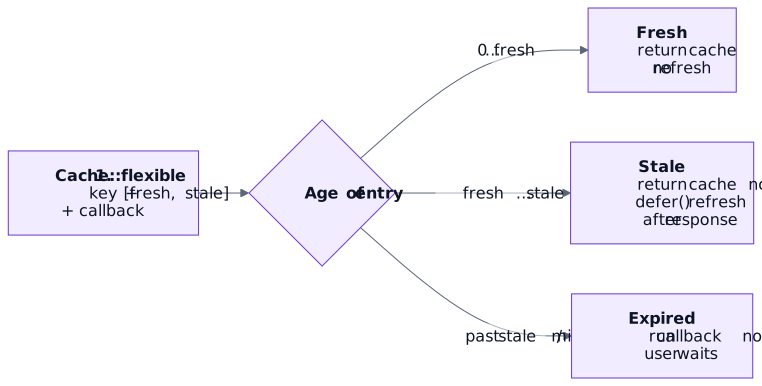
_Fresh = instant hit. Stale = instant hit + background refresh. Expired = you wait._
### What the `[fresh, stale]` pair actually means
Both numbers are **seconds from the created timestamp**, not a sliding window:
1. **`ttl[0]` (fresh):** until `created + fresh`, return the value and do nothing else.
2. **`ttl[1]` (stale / absolute TTL):** until `created + stale`, return the value **and** register a deferred refresh. The cache entry itself is stored with a TTL of `stale` seconds, so past that point both the value and the `illuminate:cache:flexible:created:…` meta key are gone.
3. **Past stale (or never stored):** run the callback inline, store value + created timestamp, TTL = `stale`.
So `[5, 30]` means: 5 seconds of pure hits, then 25 seconds of “serve old, rebuild after response”, then a real miss.
### Locks and the alwaysDefer flag
When several requests land in the stale window together, Laravel does not want every FPM worker to rebuild the same key. The refresh closure takes a cache lock (`illuminate:cache:flexible:lock:…`) and re-checks the created timestamp before writing. You can pass lock options as the fourth argument:
```php
Cache::flexible('dashboard.stats', [5, 30], $callback, lock: ['seconds' => 10]);
```
The fifth argument, `$alwaysDefer`, is passed through to `defer(..., $always)`. Set it when you want the refresh to run even if the response status is 4xx/5xx. Default is `false`, matching normal `defer()` rules (see [defer()](https://laravel-vuejs.space/laravel-defer-helper-after-response)).
## Gotchas
**Stale means stale.** The user who triggers the refresh still sees the previous value. For a homepage order count that is fine. For “can this user delete the invoice?” it is not. Do not flexible authz, balances or anything a lawyer will ask about.
> **Gotcha: forget() and the created key**
>
> `Cache::flexible` stores two keys: your value and `illuminate:cache:flexible:created:{key}`. On database and file stores, `Cache::forget($key)` also clears the created meta key. On some other drivers the meta key may linger until its own TTL; the next `flexible` call still recovers, but prefer forgetting through the same store you write with, and do not hand-delete only one of the two keys.
**The refresh uses `defer()`.** Same rules as the [defer() gem](https://laravel-vuejs.space/laravel-defer-helper-after-response): it runs after the response when the status is below 400, errors are reported and swallowed, and `php artisan serve` keeps the connection open so locally it can look like the refresh still blocks. Measure on PHP-FPM.
**First visitor after a full expiry still waits.** Flexible removes the stampede for everyone **during** the stale window. The one request that finds nothing in the cache still runs the callback inline. If that callback is 5 seconds, that one user waits 5 seconds. Pre-warm critical keys on deploy if that matters.
**Locks need a lock-capable store.** The refresh path calls `$this->store->lock(...)`. Array cache in unit tests is fine for happy paths; in production stick to Redis, database, Memcached, file or another driver that implements locks if you expect concurrent stale hits.
**Do not nest a 30-second callback inside every Inertia partial reload.** Flexible helps, but a prop that is expensive and requested on every poll still burns workers during refresh. Pair it with [Inertia once props](https://inertiajs.com/docs/v3/data-props/once-props) or a longer fresh window when the number barely moves.
> **Tip: Start with \[5, 30\] and tune**
>
> Five seconds fresh and thirty seconds total is a solid default for dashboard aggregates. Bump fresh if the number changes slowly (daily stats). Shrink stale if “wrong for half a minute” would confuse people. Log callback duration once; if it is over a couple of seconds, consider a real queued rebuild instead.
## Try it yourself
> **Prove fresh / stale / expired in tinker**
>
> ```bash
> php artisan tinker
> ```
>
> ```php
> use Illuminate\Support\Facades\Cache;
>
> Cache::flush();
> $calls = 0;
> $fn = function () use (&$calls) {
> $calls++;
> usleep(80_000);
> return "n-{$calls}";
> };
>
> Cache::flexible('demo', [1, 3], $fn); // miss, ~80 ms, n-1
> Cache::flexible('demo', [1, 3], $fn); // fresh, ~0 ms, n-1
> sleep(2);
> Cache::flexible('demo', [1, 3], $fn); // stale, ~0 ms, still n-1; refresh deferred
> app(\Illuminate\Support\Defer\DeferredCallbackCollection::class)->invoke();
> Cache::get('demo'); // n-2
> sleep(4);
> Cache::flexible('demo', [1, 3], $fn); // expired, ~80 ms, n-3
> ```
## How useful is this?
| | Score |
| --- | --- |
| Time saved per use | ★★★★☆ Swap `remember` for `flexible`, tune two numbers |
| How often you’ll reach for it | ★★★★☆ Every dashboard, public count, slow Inertia prop |
| Risk if misused | ★★★☆☆ Stale authz or money figures will bite you |
| **Overall** | **4.5 / 5**: the default for “fast enough” cached props |
If you already `Cache::remember` a count or aggregate for an Inertia page, you can switch today.
## Recap
- `Cache::flexible($key, [$fresh, $stale], $callback)` implements stale-while-revalidate on top of your cache store.
- Fresh hits return immediately. Stale hits return immediately and refresh via `defer()` after the response. Only a full miss makes the user wait.
- Concurrent stale refreshes share a named deferred callback and a cache lock.
- Keep it for aggregates and public stats; keep exact data on `remember` or uncached queries.
- It shipped in Laravel 11.23 and was tested here on Laravel 13.35.
## FAQ
**Q: Is Cache::flexible the same as Cache::remember?**
No. `remember` always recalculates inline when the TTL is gone. `flexible` adds a stale window where the old value is served and the refresh runs after the response via `defer()`.
**Q: Does the user who triggers the refresh see the new value?**
Not on that request. They get the stale value; the deferred refresh writes the new value for the next visitors. That is the point of stale-while-revalidate.
**Q: Which Laravel version do I need?**
`Cache::flexible` arrived in Laravel 11.23 (Laracon 2024 PR #52710). Everything here was tested on Laravel 13.35 with the database cache store.
**Q: How is this different from defer() alone?**
`defer()` runs arbitrary work after the response. `Cache::flexible` uses `defer()` only for the stale refresh path, and still returns a value to the current request. See [Laravel defer()](https://laravel-vuejs.space/laravel-defer-helper-after-response).
**Q: Can I use it with cache tags?**
Yes, call `flexible` on a tagged repository (`Cache::tags([...])->flexible(...)`) on drivers that support tags. Invalidation still goes through your usual `tags()->flush()` or `forget()` flow.
## Next steps
- [Laravel defer(): run code after the response](https://laravel-vuejs.space/laravel-defer-helper-after-response), the helper flexible uses for refreshes
- [Cache a prop and forget it on write](https://laravel-vuejs.space/laravel-cache-remember-vue), when plain `remember` is the right tool
- [Inertia partial reloads](https://laravel-vuejs.space/inertia-partial-reloads), so slow props are not refetching on every visit
- [Laravel docs: Stale while revalidate](https://laravel.com/docs/13.x/cache#swr)
## Sources
- [Laravel 13 docs: Stale while revalidate (`Cache::flexible`)](https://laravel.com/docs/13.x/cache#swr)
- [Laravel 13 docs: Deferred functions](https://laravel.com/docs/13.x/helpers#deferred-functions)
- [laravel/framework v11.23.0 release (Laracon 2024 PR #52710)](https://github.com/laravel/framework/releases/tag/v11.23.0)
- [laravel/framework PR #52891: Cache::flexible improvements](https://github.com/laravel/framework/pull/52891)
- [Source: `Illuminate\Cache\Repository::flexible`](https://github.com/laravel/framework/blob/13.x/src/Illuminate/Cache/Repository.php)