# Laravel Cache::withoutOverlapping() and Cache::funnel()
> One call runs a closure once at a time across workers, another allows at most N, on any lock store. 25 Pest tests and 6 real processes.
- URL: https://laravel-vuejs.space/laravel-cache-withoutoverlapping-funnel
- Author: Anass Ez-zouaine (https://laravel-vuejs.space/author/anass-ez-zouaine)
- Published: 2026-11-16
- Topics: Laravel, PHP, Testing
Someone double-clicks “Rebuild report”, and two rebuilds fight over the same table. Or twenty queue workers hit a PDF renderer that falls over at four. You know the fix is a lock, and you know it means a `try`/`catch`/`finally` you’ll copy wrong at least once. Laravel now wraps both cases in one call each.
> **TL;DR**
>
> - `Cache::withoutOverlapping('reports:rebuild', fn () => ..., lockFor: 120, waitFor: 5)` runs the closure under a lock, returns its value and always releases the lock. If it can’t get the lock in time, it throws `LockTimeoutException`.
> - `Cache::funnel('pdf')->limit(3)->releaseAfter(120)->block(5)->then($run, $busy)` lets at most 3 callers in at once. It works on any store with locks, not only Redis. With 6 real processes: no guard ran 6 at once, `withoutOverlapping` ran 1, `funnel(3)` ran 3.
> - Always pass `lockFor`. The default is `0`: Redis then never expires the lock, and the database store keeps it for 86,400 seconds. One killed worker blocks the job for a day.
>
> **What you'll learn**
>
> - How `Cache::withoutOverlapping()` replaces the lock/block/release dance
> - How `Cache::funnel()` allows N at a time on database, file or Redis
> - Wiring a busy state to a Vue button and a queued job
> - The `lockFor: 0` default that can lock you out for a day
>
> **Who it's for:** Laravel + Vue developers with more than one request, worker or server touching the same work
>
> **Tested with:** Laravel 13.42 · PHP 8.4 · Pest 4 · inertia-laravel 3.5.1 (25 tests, 70 assertions, plus 6 real PHP processes)
Sponsor
## What withoutOverlapping and funnel are, and why people miss them
Both are thin wrappers over Laravel’s atomic locks. `Cache::withoutOverlapping()` is `Cache::lock()->block()` with a closure, so only one caller runs at a time. `Cache::funnel()` is a counting lock: it tries slots `1..N` and runs your closure in the first free one.
They are recent. `withoutOverlapping()` shipped in Laravel 12.47 in January 2026 ([PR #58303](https://github.com/laravel/framework/pull/58303)), and enum keys followed in 12.49 ([#58444](https://github.com/laravel/framework/pull/58444)). `funnel()` shipped in 12.53 in February 2026 ([#58439](https://github.com/laravel/framework/pull/58439)). Both are in every 13.x release.
People miss them because the name sounds familiar. `->withoutOverlapping()` on a scheduled task and the `WithoutOverlapping` job middleware have existed for years, and `Redis::funnel()` only works on a Redis connection. These two live on the cache facade, work in a controller, a job or a command, and run on the database store your app already has.
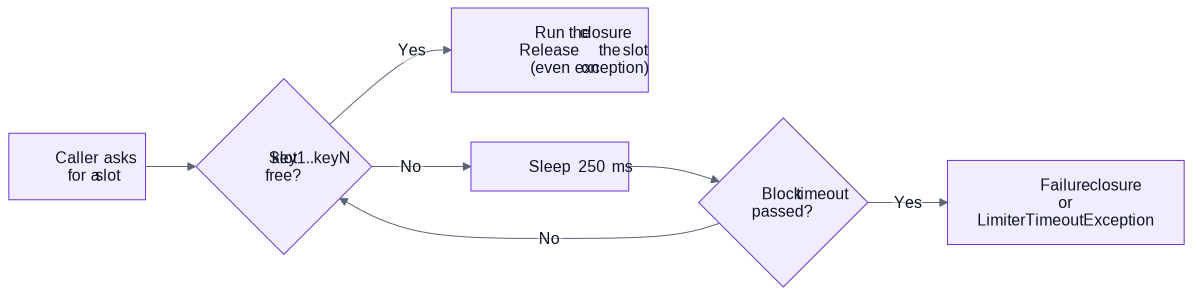
_withoutOverlapping() is a funnel with one slot. Both release the slot in a finally._
## The usual way vs withoutOverlapping
The classic lock code has three jobs: wait for the lock, run the work, release the lock even when the work throws. Here it is next to the gem, both from our lab:
**Cache::lock() by hand:**
`app/Actions/RebuildSalesReport.php`
```php
use Illuminate\Contracts\Cache\LockTimeoutException;
use Illuminate\Support\Facades\Cache;
$lock = Cache::lock('reports:rebuild', 120);
try {
$lock->block(5);
$result = SalesReport::rebuild();
} catch (LockTimeoutException) {
$result = 'busy';
} finally {
$lock->release();
}
```
**Cache::withoutOverlapping():**
`app/Actions/RebuildSalesReport.php`
```php
use Illuminate\Contracts\Cache\LockTimeoutException;
use Illuminate\Support\Facades\Cache;
try {
$result = Cache::withoutOverlapping(
'reports:rebuild',
fn () => SalesReport::rebuild(),
lockFor: 120,
waitFor: 5,
);
} catch (LockTimeoutException) {
$result = 'busy';
}
```
The gem returns whatever the closure returns. In the lab, the lock was held inside the closure and free right after. When the closure threw `RuntimeException('boom')`, the exception reached us and the lock was released anyway.
The arguments are `lockFor` (seconds the lock lives) and `waitFor` (seconds to wait for it, default 10). While waiting it retries every 250 ms. `waitFor: 0` tries once: in our lab it gave up after 0.1 ms. The key can be a backed enum, so `LockKey::ReportRebuild` works where you’d pass `'reports:rebuild'`.
## Cache::funnel(): at most N at a time
Sometimes one at a time is too strict. Your PDF renderer is happy with 3 parallel jobs, the partner API allows 5 concurrent connections, and the 4th caller should wait or back off.
`app/Services/InvoicePdf.php`
```php
use Illuminate\Support\Facades\Cache;
return Cache::funnel('pdf-renderer')
->limit(3) // at most 3 at once
->releaseAfter(120) // a slot expires after 120 s if a process dies
->block(5) // wait up to 5 s for a free slot
->then(
fn () => $this->render($invoice),
fn ($e) => null, // all slots busy: $e is a LimiterTimeoutException
);
```
`then()` returns the first closure’s value, or the failure closure’s value when no slot frees up. Leave the second closure out and you get an `Illuminate\Cache\Limiters\LimiterTimeoutException` instead. A slot is freed when the closure throws, too.
Under the hood each slot is a normal cache lock named after the key plus a number. With two funnel calls nested, `pdf-renderer1` and `pdf-renderer2` were locked and `pdf-renderer3` was free. The defaults are `releaseAfter(60)`, `block(3)` and a 250 ms poll, which you can change with `->sleep(1000)`.
| | `Redis::funnel()` | `Cache::funnel()` |
| --- | --- | --- |
| Stores | Redis connection only | Any store with locks: database, file, Redis, Memcached, DynamoDB, array |
| Since | Laravel 5.5 | Laravel 12.53 |
| Typical use | Queue job middleware on Redis | Anywhere, including apps on the database store |
## Real processes, real numbers
Unit tests with the array store prove the logic, not the concurrency. So we started 6 real PHP processes at once with `Process::pool()`. Each one booted the app, took the guard on the `file` store, and did 300 ms of fake work.
| Guard | Ran | Most at the same time | Wall time |
| --- | --- | --- | --- |
| None | 6 | 6 | ~0.55 s |
| `withoutOverlapping(lockFor: 30, waitFor: 10)` | 6 | 1 | ~2.8–3.0 s |
| `funnel()->limit(3)->block(10)` | 6 | 3 | ~1.0 s |
| `withoutOverlapping(waitFor: 0)` | 1 | 1 | 5 of 6 got “busy” |
The last row is the “don’t queue up, just say no” mode. Five processes got a `LockTimeoutException` right away and printed “busy”. That’s the behaviour you want behind a button.
## Real-world example: a “Rebuild report” button in Vue
Disabling the button while the request runs stops one double-click. It does nothing about a second tab, a colleague, or the nightly command doing the same rebuild. The lock does.
`app/Http/Controllers/ReportRebuildController.php`
```php
use App\Actions\SalesReport;
use Illuminate\Contracts\Cache\LockTimeoutException;
use Illuminate\Support\Facades\Cache;
use Inertia\Inertia;
class ReportRebuildController
{
public function __invoke()
{
try {
Cache::withoutOverlapping(
'reports:rebuild',
fn () => SalesReport::rebuild(),
lockFor: 120,
waitFor: 0,
);
} catch (LockTimeoutException) {
Inertia::flash('toast', [
'type' => 'error',
'message' => 'A rebuild is already running. Try again in a minute.',
]);
return back();
}
Inertia::flash('toast', ['type' => 'success', 'message' => 'Report rebuilt.']);
return back();
}
}
```
The Vue page stays boring, which is the point. On the starter kit, the `toast` flash shows up without extra code (see [flash messages](https://laravel-vuejs.space/laravel-vue-flash)):
`resources/js/pages/Reports/Index.vue`
```vue
```
In the lab, the first POST flashed `toast.type = success`. With the lock held by “someone else”, the second POST flashed `error`, and `SalesReport::rebuild()` ran exactly once.
> **Tip: Long rebuild? Lock in the controller, release in the job**
>
> If the rebuild is queued, take the lock with `Cache::lock('reports:rebuild', 600)->get()`, pass `$lock->owner()` to the job, and release it there with `Cache::restoreLock('reports:rebuild', $owner)->release()`. `withoutOverlapping()` is for work that finishes inside the closure.
## Real-world example: a queued job that backs off
For queued work, a busy funnel should not fail the job. Put it back on the queue instead:
`app/Jobs/RenderInvoicePdf.php`
```php
use Illuminate\Contracts\Queue\ShouldQueue;
use Illuminate\Foundation\Queue\Queueable;
use Illuminate\Support\Facades\Cache;
class RenderInvoicePdf implements ShouldQueue
{
use Queueable;
public function __construct(public int $invoiceId) {}
public function handle(): void
{
Cache::funnel('pdf-renderer')
->limit(3)
->releaseAfter(120)
->block(5)
->then(
fn () => $this->render(),
fn () => $this->release(10),
);
}
}
```
We tested it with `withFakeQueueInteractions()`. With all 3 slots held, `handle()` called `release(10)` and rendered nothing. After one slot was force-released, the next job rendered and was not released.
## Which “without overlapping” do you need?
Laravel has several tools with similar names. They solve different problems:
| You want | Use |
| --- | --- |
| A scheduled command never runs twice at once | `Schedule::command(...)->withoutOverlapping()` |
| Two jobs for the same model never run at once | `WithoutOverlapping` job middleware |
| Only one copy of a job sits in the queue | `ShouldBeUnique` |
| One block of code runs once at a time, anywhere | `Cache::withoutOverlapping()` |
| At most N copies of a block run at once | `Cache::funnel()` |
## Gotchas
> **Gotcha: lockFor: 0 means 'until released', and a dead process never releases**
>
> `withoutOverlapping()` defaults to `lockFor: 0`. `RedisLock` then sets the key with no expiry at all. The database store falls back to its default timeout: in the lab, `cache_locks.expiration` was exactly now + 86,400 s. We simulated a worker killed mid-run: the lock still blocked callers at 86,399 s and only freed at 86,400 s. Always pass `lockFor`, a bit longer than the slowest run. A stuck lock can be cleared with `Cache::lock('reports:rebuild')->forceRelease()`.
Other traps we hit:
- Too short is wrong as well. When the work ran 121 s with `lockFor: 120`, a second caller got in. Same for a funnel slot after `releaseAfter(60)`. For long loops, take `Cache::lock()` yourself and call `$lock->refresh()`.
- The `null` cache store hands out locks that never block. Nested `withoutOverlapping()` calls on it both ran. If a test or staging env sets `CACHE_STORE=null`, your guard is gone.
- The `array` and `file` stores only lock within one process or one server. Across servers you need a shared store: database, Redis, Memcached or DynamoDB.
- Funnel slots are plain locks named key + number, so `funnel('pdf')` uses `pdf1`, `pdf2`, … An unrelated `Cache::lock('pdf1')` blocked a `funnel('pdf')->limit(1)` in the lab. Use a distinct key like `funnel:pdf:`.
- `funnel()->block()` counts whole seconds, `withoutOverlapping()` counts milliseconds. `block(3)` gave up after 3 s when it started on a round second, and after 2.25 s when it started at `.900`.
- The exceptions differ: `withoutOverlapping()` throws `Illuminate\Contracts\Cache\LockTimeoutException`, `funnel()` throws `Illuminate\Cache\Limiters\LimiterTimeoutException`.
## Testing it without waiting
Both helpers wait through Laravel’s `Sleep` class, so [`Sleep::fake()`](https://laravel-vuejs.space/laravel-sleep-fake-test-retries) skips the waits. Use `syncWithCarbon: true`, because the timeouts read the clock:
`tests/Feature/ReportRebuildTest.php`
```php
use Illuminate\Contracts\Cache\LockTimeoutException;
use Illuminate\Support\Facades\Cache;
use Illuminate\Support\Sleep;
it('gives up after 5 seconds when a rebuild is running', function () {
Cache::lock('reports:rebuild', 60)->get();
Sleep::fake(syncWithCarbon: true);
expect(fn () => Cache::withoutOverlapping('reports:rebuild', fn () => 1, waitFor: 5))
->toThrow(LockTimeoutException::class);
Sleep::assertSleptTimes(19); // 19 x 250 ms, recorded in under 2 ms
});
```
For `funnel()`, this needs Laravel 13.37 or later. [PR #62017](https://github.com/laravel/framework/pull/62017) made the limiter’s timeout read Carbon instead of `time()`, so a faked sleep can end it.
## Try it yourself
> **Watch the second caller bounce**
>
> ```bash
> php artisan tinker
> ```
>
> ```php
> Cache::lock('demo', 60)->get(); // pretend someone is busy
>
> Cache::withoutOverlapping('demo', fn () => 'ran', lockFor: 10, waitFor: 0);
> // LockTimeoutException
>
> Cache::funnel('funnel:demo:')->limit(2)->block(0)->then(fn () => 'ran', fn () => 'busy');
> // "ran": the funnel has its own slots
>
> Cache::lock('demo')->forceRelease();
> Cache::withoutOverlapping('demo', fn () => 'ran', lockFor: 10, waitFor: 0);
> // "ran"
> ```
## How useful is this?
| | Score |
| --- | --- |
| Time saved per use | ★★★★☆ One call replaces lock/try/catch/finally, and funnel replaces a hand-built semaphore |
| How often you’ll reach for it | ★★★★☆ Buttons that start heavy work, imports, syncs, rate-limited partners, any app with 2+ workers |
| Risk if misused | ★★★☆☆ Forget `lockFor` and one crash locks the job for a day |
| **Overall** | **4.5 / 5**: the cheapest race-condition fix in Laravel |
## Recap
- `Cache::withoutOverlapping($key, $closure, lockFor:, waitFor:)` runs once at a time, returns the closure’s value, and always releases the lock.
- `Cache::funnel($key)->limit(N)->releaseAfter()->block()->then($run, $busy)` runs at most N at a time on any lock store.
- With 6 real processes: no guard ran 6 at once, `withoutOverlapping` 1, `funnel(3)` 3.
- Always set `lockFor` and `releaseAfter`, longer than the slowest run and shorter than “forever”.
- Test with `Sleep::fake(syncWithCarbon: true)`; funnel needs 13.37+ for that.
## FAQ
**Q: What is the difference between Cache::withoutOverlapping() and Cache::lock()?**
withoutOverlapping() is Cache::lock($key, $lockFor)->block($waitFor, $closure). It waits for the lock, runs the closure, returns its value and releases the lock in a finally block. Use Cache::lock() directly when you need refresh(), owner() or to release the lock in another process.
**Q: Does Cache::funnel() need Redis?**
No. It works on any cache store that supports locks: database, file, Redis, Memcached, DynamoDB and array. Calling it on a store without locks throws a BadMethodCallException. For several servers, use a shared store such as database or Redis.
**Q: What happens if the process dies while holding the lock?**
The lock stays until it expires. With the default lockFor of 0, Redis never expires it and the database store keeps it for 86,400 seconds. Always pass lockFor, or clear a stuck lock with Cache::lock($key)->forceRelease().
**Q: Which Laravel version do I need?**
withoutOverlapping() arrived in Laravel 12.47 and funnel() in 12.53, both in early 2026, and both are in Laravel 13. For tests that fake Sleep with a blocked funnel, use 13.37 or later.
**Q: Should I use this or the WithoutOverlapping job middleware?**
Use the job middleware when the whole job must not overlap with another job for the same key. Use Cache::withoutOverlapping() or Cache::funnel() for a block of code inside a controller, command or job, or when you need N at a time instead of one.
## Next steps
- [Laravel Sleep::fake()](https://laravel-vuejs.space/laravel-sleep-fake-test-retries), to test the waits in milliseconds
- [Queue jobs and HTTP 429](https://laravel-vuejs.space/laravel-queue-429-rate-limited-api), for `release()` and backoff on rate-limited APIs
- [Flash messages in Laravel and Vue](https://laravel-vuejs.space/laravel-vue-flash), the toast behind the busy message
- [Laravel docs: Atomic locks](https://laravel.com/docs/13.x/cache#atomic-locks)
## Sources
- [Laravel docs: Atomic locks and concurrency limiting](https://laravel.com/docs/13.x/cache#concurrency-limiting)
- [Laravel docs: Preventing job overlaps](https://laravel.com/docs/13.x/queues#preventing-job-overlaps)
- [PR #58303: Add `Cache::withoutOverlapping()`](https://github.com/laravel/framework/pull/58303) (Laravel 12.47)
- [PR #58444: Enum keys in `Cache::flexible()` and `withoutOverlapping()`](https://github.com/laravel/framework/pull/58444) (Laravel 12.49)
- [PR #58439: Add `Cache::funnel()`](https://github.com/laravel/framework/pull/58439) (Laravel 12.53)
- [PR #62017: Respect faked Sleep in limiter `block()` timeout](https://github.com/laravel/framework/pull/62017) (Laravel 13.37)
- [Source: `Illuminate\Cache\Repository::withoutOverlapping()` and `funnel()`](https://github.com/laravel/framework/blob/13.x/src/Illuminate/Cache/Repository.php)
- [Source: `Illuminate\Cache\Limiters\ConcurrencyLimiter`](https://github.com/laravel/framework/blob/13.x/src/Illuminate/Cache/Limiters/ConcurrencyLimiter.php)
- [Source: `Illuminate\Cache\Lock::block()`](https://github.com/laravel/framework/blob/13.x/src/Illuminate/Cache/Lock.php)