# Laravel once(): memoize anything per request in one line
> Hidden gem: once() runs a closure one time per object and returns the cached result after that. One line replaces private cache properties, plus 5 gotchas we tested.
- URL: https://laravel-vuejs.space/laravel-once-helper-memoization
- Author: Anass Ez-zouaine (https://laravel-vuejs.space/author/anass-ez-zouaine)
- Published: 2026-11-02
- Topics: Laravel, VueJs, PHP, Inertia
Your `HandleInertiaRequests` middleware asks the user for their permissions. So does the policy. So does the controller, twice. Four identical queries for one page, and the usual fix is a `private ?array $permissions = null` property with an `if` around it. Laravel has shipped a one-line replacement since 11.0, and most apps still hand-roll the property.
> **TL;DR**
>
> - `return once(fn () => $this->expensive());` runs the closure the first time and returns the stored result on every later call. Inside an object, the cache belongs to that instance.
> - Variables the closure captures are part of the key, so `once(fn () => $this->price($id))` caches per `$id` with no extra code.
> - In our Inertia lab, a page that read permissions four times ran 4 permission queries before and 1 after.
> - Watch out: in static methods and plain functions the cache is process-wide, and a queue worker never clears it. Our second job read a stale setting until we added `Queue::before(fn () => Once::flush())`.
>
> **What you'll learn**
>
> - What `once()` caches and how it builds its key
> - The private-property pattern vs `once()`, side by side
> - An Inertia permissions example that drops 4 queries to 1
> - Gotchas: queue workers, `$this` properties, value objects, tinker, fresh model instances
>
> **Who it's for:** Laravel 11+ developers, including Inertia + Vue apps with shared props, policies and service classes
>
> **Tested with:** Laravel 13.39 · PHP 8.4 · SQLite · inertia-laravel 3.5 · Pest (13 tests, 45 assertions) + a real database queue worker
Sponsor
## What once() is and why most people miss it
`once()` is a global helper that arrived in Laravel 11.0, added by Nuno Maduro in [PR #49744](https://github.com/laravel/framework/pull/49744) (merged January 19, 2024). You hand it a closure. The first call runs it, and every later call from the same place returns the stored result:
`app/Services/ExchangeRates.php`
```php
class ExchangeRates
{
public function all(): array
{
return once(fn () => Http::get('https://rates.example.test/latest')->json());
}
}
$rates = app(ExchangeRates::class);
$rates->all(); // HTTP call
$rates->all(); // cached, no HTTP call
```
Why people miss it: it shipped inside the Laravel 11 release, which was busy with the slim skeleton, Reverb and per-second rate limiting. The [docs entry](https://laravel.com/framework/docs/13.x/helpers#method-once) is a few lines in the “Miscellaneous” helpers list, alphabetically between `old()` and `optional()`. If you didn’t read the helpers page top to bottom, you never saw it.
It keeps getting better, too. Laravel 11.36.1 made it remember `null` results ([PR #53949](https://github.com/laravel/framework/pull/53949)), Laravel 12.19 added the `HasOnceHash` interface for value objects ([PR #56009](https://github.com/laravel/framework/pull/56009)), and Laravel 13.39 (October 27, 2026) fixed a subtle bug where a new object could receive an old object’s cached value ([PR #62121](https://github.com/laravel/framework/pull/62121)).
### How once() builds its cache key
[The source](https://github.com/laravel/framework/blob/13.x/src/Illuminate/Support/Onceable.php) hashes four things: the file and line of the `once()` call, the class and method it sits in, and the variables the closure captures. Then it stores the result:
- **Inside an object**: in a `WeakMap` keyed by `$this`. Each instance has its own cache, and it disappears when the object does.
- **In a static method or plain function**: in one shared bucket for the whole PHP process.
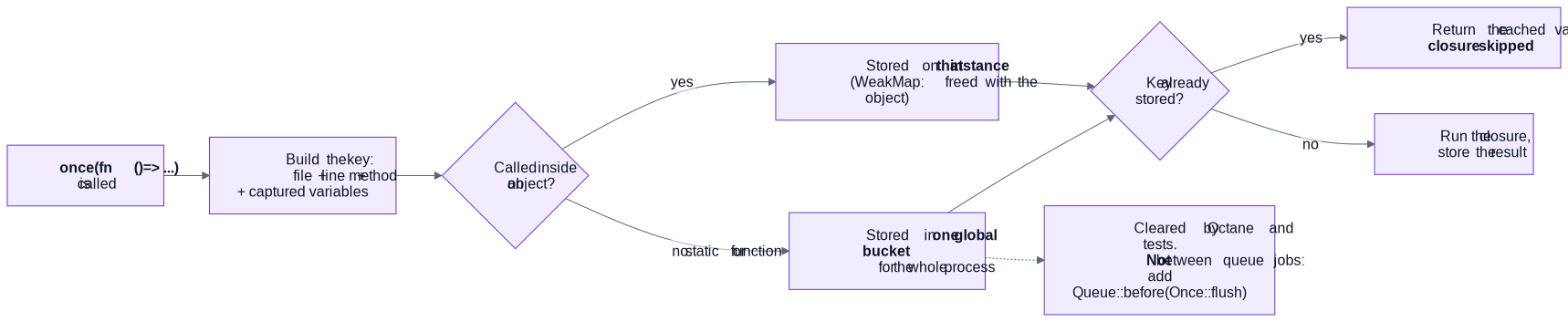
_Per object, or per process. That one branch explains every gotcha below._
## The usual way vs once()
Both versions below ran 1 permission query for three `can()` checks in our lab. One of them needs a property, a null check and a comment explaining why the property exists.
**private cache property:**
`app/Models/User.php`
```php
private ?array $permissionNames = null;
public function permissionNames(): array
{
if ($this->permissionNames === null) {
$this->permissionNames = $this->permissions()->pluck('name')->all();
}
return $this->permissionNames;
}
```
**once():**
`app/Models/User.php`
```php
public function permissionNames(): array
{
return once(fn () => $this->permissions()->pluck('name')->all());
}
```
The `once()` version has a bonus: you can’t forget to reset the property, because there isn’t one. And when the method takes arguments, the hand-rolled version grows an array keyed by `$id`. `once()` handles that for free:
`app/Services/Pricing.php`
```php
public function priceFor(int $productId): int
{
return once(fn () => $this->calculate($productId)); // cached per $productId
}
```
In the lab, `priceFor(1)`, `priceFor(2)`, `priceFor(1)` ran the closure twice, not three times. Arrow functions and `function () use ($productId)` both work, because both capture the variable.
| | Private property | `Cache::remember` | `once()` |
| --- | --- | --- | --- |
| Lives for | the object | until the TTL ends | the object (or the process, see gotchas) |
| Survives the request | no | yes, in Redis/DB | no |
| Per-argument caching | a hand-built array | a hand-built key | automatic, from captured variables |
| Lines of code | 5–8 | 1, plus a key and TTL | 1 |
| Good for | same as `once()`, with more typing | data shared across users and requests | repeated work inside one request or job |
> **Tip: Not the same thing as Inertia's once props**
>
> Inertia also has “once props”, which the browser remembers across page visits. PHP’s `once()` lives in server memory for a single request (or object). They solve different problems and you can use both on the same page.
## Real-world example: Inertia permissions without repeated queries
The classic Inertia page reads permissions in three places: the middleware shares them with Vue, the controller gates the page, and the props expose `can.create` and `can.export` for the buttons.
`app/Models/User.php`
```php
public function permissionNames(): array
{
return once(fn () => $this->permissions()->pluck('name')->all());
}
public function canDo(string $permission): bool
{
return in_array($permission, $this->permissionNames(), true);
}
```
`app/Http/Middleware/HandleInertiaRequests.php`
```php
public function share(Request $request): array
{
return [
...parent::share($request),
'auth' => [
'user' => $request->user()?->only('id', 'name'),
'permissions' => fn () => $request->user()?->permissionNames() ?? [],
],
];
}
```
`app/Http/Controllers/InvoiceController.php`
```php
public function index(Request $request): Response
{
$user = $request->user();
abort_unless($user->canDo('invoices.view'), 403);
return Inertia::render('Invoices/Index', [
'invoices' => $user->team->invoices()->latest()->paginate(20),
'can' => [
'create' => $user->canDo('invoices.create'),
'export' => $user->canDo('invoices.export'),
],
]);
}
```
`$request->user()` returns the same `User` instance everywhere in the request, so all four reads share one cache. We ran this shape in a Pest test with an `X-Inertia` request: **4 permission queries without `once()`, 1 with it**, and the JSON props were identical.
On the Vue side nothing changes. The props arrive as plain arrays and booleans:
`resources/js/pages/Invoices/Index.vue`
```vue
```
Other good homes for `once()`: a service that loads a tenant’s settings, a report class that computes totals used by three charts, a `Feature` check that hits the database, an exchange-rate lookup inside a cart that prices 40 lines.
## Gotchas
> **Gotcha: Static methods and queue workers: the cache never resets**
>
> Outside an object, `once()` stores the result for the whole PHP process. In a web request that is fine, because the process handles one request. In a queue worker it is not. We dispatched two jobs to a real database queue; job 1 read the theme with a static `Settings::current()` and then changed it to `dark`:
>
> ```text
> job 1: once() says light, database says light
> job 2: once() says light, database says dark
> ```
>
> Octane clears the cache for you (its `FlushOnce` listener runs after each operation), and Laravel’s test case flushes it between tests. The queue worker doesn’t. One line in `AppServiceProvider::boot()` fixed it in the lab:
>
> `app/Providers/AppServiceProvider.php`
> ```php
> Queue::before(fn () => Once::flush()); // use Illuminate\Support\Once;
> ```
>
> Same two jobs afterwards: `job 2: once() says dark, database says dark`.
**`$this` properties are not part of the key.** Only captured variables are. In the lab, `once(fn () => "Prices in {$this->currency}")` kept returning `USD` after we set `$this->currency = 'MYR'`. If a property can change, pass it in: `$currency = $this->currency; return once(fn () => ... $currency ...);`.
**Equal value objects are different keys.** `tagFor(new ProductId(7))` called twice ran the closure twice, because each `ProductId` is a new object. Implement `Illuminate\Contracts\Support\HasOnceHash` and return a string from `onceHash()`, and the second call became a cache hit (2 runs down to 1 in our test).
**A fresh model instance has a fresh cache.** `Member::find(1)->canDo(...)` builds a new object, so it queries again. The trick only works when you reuse the instance, like `$request->user()` or a model you already loaded.
**Exceptions are not cached, `null` is.** A closure that throws runs again on the next call (good for flaky APIs). A closure that returns `null` is remembered (since 11.36.1), so don’t use `null` to mean “try again later”.
**It does nothing in tinker.** Code evaluated with `eval()` skips memoization on purpose, so `once()` in a tinker session runs every time. Call a method from a real class file to try it.
> **Heads up: On Laravel 13.38 or older? Upgrade before caching per object**
>
> Before [PR #62121](https://github.com/laravel/framework/pull/62121), the key used `spl_object_id()` for captured objects, and PHP reuses ids as soon as an object is freed. So a loop like `foreach (User::lazy() as $user) $billing->discountFor($user);` can hand every user the first user’s result, with no error.
>
> We ran the same loop with six short-lived customers (tiers 1 to 6, discount = tier × 10). Laravel 13.38 returned `[10, 10, 10, 10, 10, 10]`. Laravel 13.39, which keeps a weak reference to each captured object and checks it, returned `[10, 20, 30, 40, 50, 60]`.
## Try it yourself
> **Count how many times the closure runs**
>
> `routes/console.php`
> ```php
> use Illuminate\Support\Facades\Artisan;
>
> Artisan::command('once:check', function () {
> $service = new class {
> public int $runs = 0;
>
> public function slow(int $id): int
> {
> return once(function () use ($id) {
> $this->runs++;
> usleep(200_000);
>
> return $id * 2;
> });
> }
> };
>
> foreach ([1, 1, 2, 1, 2] as $id) {
> $service->slow($id);
> }
>
> $this->info("5 calls, {$service->runs} real runs"); // 5 calls, 2 real runs
> });
> ```
>
> ```bash
> php artisan once:check
> ```
Now grep your app for `?array $` and `=== null) {` inside getters. Each match is a candidate for a one-line `once()`.
## How useful is this?
| | Score |
| --- | --- |
| Time saved per use | ★★★☆☆ A property, a null check and a reset become one line |
| How often you’ll reach for it | ★★★★☆ Permissions, settings, services, report totals |
| Risk if misused | ★★★☆☆ Stale values in queue workers and from `$this` properties |
| **Overall** | **4 / 5**: tiny API, real query savings, and two gotchas worth one line of setup |
## Recap
- `once()` runs a closure once and returns the stored result after that, per object instance.
- Captured variables are part of the key, so per-argument caching is automatic; `$this` properties are not.
- In static methods and plain functions the cache is process-wide: add `Queue::before(fn () => Once::flush())` for queue workers.
- Use `HasOnceHash` for value objects, reuse model instances, and run Laravel 13.39+ if you capture objects.
- Tested with 13 Pest tests in a scratch Laravel 13.39 app, an Inertia endpoint and a real database queue worker.
## FAQ
**Q: Which Laravel version has the once() helper?**
Laravel 11.0 (PR #49744, merged January 2024). `null` results are remembered since 11.36.1, `HasOnceHash` arrived in 12.19, and 13.39 fixed cached values leaking between freed and new objects. We tested on 13.39.
**Q: Is once() the same as Cache::remember?**
No. `Cache::remember` stores data in Redis, the database or files, shared across requests until a TTL ends. `once()` keeps the value in PHP memory for one object or one request. Use `once()` for repeated work inside a request, and the cache for data many requests share.
**Q: Does once() work with Laravel Octane?**
Yes. Octane registers a `FlushOnce` listener that clears the cache after each request, task or tick, so values do not leak between users. Queue workers have no such listener, so add `Queue::before(fn () => Once::flush())` yourself.
**Q: How do I turn once() off in a test?**
Call `Illuminate\Support\Once::disable()` and `Once::enable()` afterwards. Laravel's base test case already calls `Once::flush()` between tests, so values never leak from one test to the next.
**Q: Is PHP once() related to Inertia once props?**
Only by name. Inertia once props are remembered by the browser across visits, so the server can skip sending them. PHP `once()` memoizes a closure on the server. They work well together.
## Next steps
- [Inertia shared props in Vue](https://laravel-vuejs.space/inertia-vue-persistent-layout#shared-props-for-the-layout), where the permissions example plugs in
- [Laravel + Vue permissions](https://laravel-vuejs.space/laravel-vue-policies#roles-and-permissions-with-spatie), for the full roles and abilities setup
- [Cache::flexible](https://laravel-vuejs.space/laravel-cache-flexible-swr), when the value should survive across requests
- [Laravel docs: once()](https://laravel.com/framework/docs/13.x/helpers#method-once)
## Sources
- [Laravel 13 docs: once()](https://laravel.com/framework/docs/13.x/helpers#method-once)
- [laravel/framework PR #49744: Adds once memoization function (Laravel 11.0)](https://github.com/laravel/framework/pull/49744)
- [laravel/framework PR #53949: Once remember null values](https://github.com/laravel/framework/pull/53949)
- [laravel/framework PR #56009: ComputesOnceableHashInterface, now HasOnceHash](https://github.com/laravel/framework/pull/56009)
- [laravel/framework PR #62121: Fix once() returning a cached value for a different object (Laravel 13.39)](https://github.com/laravel/framework/pull/62121)
- [Source: `Illuminate\Support\Once` and `Onceable`](https://github.com/laravel/framework/blob/13.x/src/Illuminate/Support/Onceable.php)
- [Laravel Octane: FlushOnce listener](https://github.com/laravel/octane/blob/2.x/src/Listeners/FlushOnce.php)