# Laravel whereAny, whereAll, whereNone: multi-column search without the orWhere trap
> Hidden gem: whereAny() searches many columns in one grouped call, so a chained orWhere can't leak other teams' rows. Plus whereAll, whereNone and 4 gotchas.
- URL: https://laravel-vuejs.space/laravel-whereany-whereall-wherenone
- Author: Anass Ez-zouaine (https://laravel-vuejs.space/author/anass-ez-zouaine)
- Published: 2026-10-29
- Topics: Laravel, VueJs, PHP, Inertia
Your search box needs to match name, email or phone. So you chain `orWhere()` three times, ship it, and a week later someone on team 1 searches “sam” and sees a contact from team 2. One missing closure turned your tenant filter into a suggestion. Laravel has had a one-call fix for this since 10.47, and most codebases still write the closure by hand.
> **TL;DR**
>
> - `->whereAny(['name', 'email', 'phone'], 'like', "%{$search}%")` compiles to `(name like ? or email like ? or phone like ?)`, already wrapped in parentheses. Same SQL as the `where(fn ...)` closure you write by hand, in one line.
> - Chaining `orWhere` without that closure is how tenant filters break: in our lab, `where('team_id', 1)` plus two `orWhere` calls returned a team 2 contact. `whereAny` returned only team 1.
> - `whereAll` is the AND version (every column matches), `whereNone` is `NOT (... or ...)` (no column matches). The column list can also hold closures.
> - Watch out: `whereNone` silently drops rows where any listed column is NULL, and an empty column list adds no filter at all.
>
> **What you'll learn**
>
> - What `whereAny`, `whereAll` and `whereNone` compile to
> - Why chained `orWhere` leaks rows and how `whereAny` groups them for you
> - A team-scoped Inertia contacts search with a multi-word variant
> - Gotchas: NULL columns in whereNone, empty column lists, closures that are not Eloquent, Postgres case
>
> **Who it's for:** Laravel 10.47+ developers building search boxes and filters, including Inertia + Vue apps
>
> **Tested with:** Laravel 13.39 · PHP 8.4 · SQLite · inertia-laravel 3.5 · Pest (14 tests, 57 assertions)
Sponsor
## What whereAny is and why most people miss it
`whereAny` and `whereAll` arrived in Laravel 10.47 (March 5, 2024, [PR #50344](https://github.com/laravel/framework/pull/50344)). `whereNone` followed in Laravel 11.19 (July 30, 2024, [PR #52260](https://github.com/laravel/framework/pull/52260)). They apply one condition to a list of columns:
`app/Http/Controllers/ContactController.php`
```php
Contact::query()
->where('team_id', $teamId)
->whereAny(['name', 'email', 'phone'], 'like', "%{$search}%")
->get();
```
```sql
select * from "contacts"
where "team_id" = ? and ("name" like ? or "email" like ? or "phone" like ?)
```
Why people miss them: they shipped in point releases, not in a major version’s headline list. The [docs section](https://laravel.com/docs/13.x/queries#where-any-all-none-clauses) sits between “Where Not” and “JSON Where”, easy to scroll past. And every search tutorial (and every autocomplete trained on them) predates it, so the `where(function ($q) { ... })` closure is pure muscle memory.
[Under the hood](https://github.com/laravel/framework/blob/13.x/src/Illuminate/Database/Query/Builder.php) it is a loop inside `whereNested()`: each column gets a `where()` joined with `or` (for `whereAny`) or `and` (for `whereAll`). `whereNone` is `whereAny` with `not` in front. The parentheses come from `whereNested()`, which is exactly the part people forget.
## The usual way vs whereAny
Both versions below produced the identical SQL string and bindings in our lab. One of them fits on a slide.
**nested where closure:**
`app/Http/Controllers/ContactController.php`
```php
Contact::query()
->where('team_id', $teamId)
->where(function ($query) use ($search) {
$query->where('name', 'like', "%{$search}%")
->orWhere('email', 'like', "%{$search}%")
->orWhere('phone', 'like', "%{$search}%");
})
->get();
```
**whereAny:**
`app/Http/Controllers/ContactController.php`
```php
Contact::query()
->where('team_id', $teamId)
->whereAny(['name', 'email', 'phone'], 'like', "%{$search}%")
->get();
```
The closure version is correct. The trouble is the version people write when they are in a hurry, without the closure:
```php
Contact::where('team_id', 1)
->where('name', 'like', '%sam%')
->orWhere('email', 'like', '%sam%') // not grouped
->get();
```
SQL evaluates `and` before `or`, so that reads as “(team 1 and name matches) or (any team’s email matches)”. In the lab, it returned Samir from team 1 and Sam from team 2. The `whereAny` version returned Samir only.
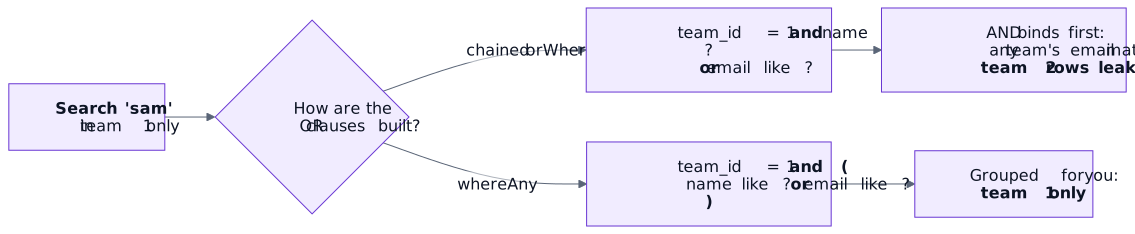
_Same search, same columns. The parentheses are the whole difference._
| Method | SQL shape | Use it for |
| --- | --- | --- |
| `whereAny($cols, $op, $value)` | `(a op ? or b op ? or c op ?)` | Search boxes: match any column |
| `whereAll($cols, $op, $value)` | `(a op ? and b op ? and c op ?)` | Thresholds: every column must pass |
| `whereNone($cols, $op, $value)` | `not (a op ? or b op ? or c op ?)` | Exclusions: no column may match |
| `orWhereAny` / `orWhereAll` / `orWhereNone` | same, joined with `or` | Adding a grouped alternative |
| Two arguments: `whereAny($cols, $value)` | operator defaults to `=` | Exact lookups: phone or email |
`whereAll` reads nicely for stock alerts. In the lab, this returned only the mug, the one product low in every region:
```php
DB::table('stock')->whereAll(['eu', 'us', 'asia'], '<', 5)->pluck('sku'); // ['MUG']
```
Swap it for `whereAny` and you get every product low in at least one region (`['MUG', 'TEE']`).
> **Tip: Closures work in the column list**
>
> The list may also hold closures, each one becoming its own group inside the OR. It worked from the start; Laravel 11.22 ([PR #52555](https://github.com/laravel/framework/pull/52555)) made it official with types and tests:
>
> ```php
> Contact::whereAny([
> fn ($query) => $query->whereLike('name', $term),
> fn ($query) => $query->whereLike('email', $term),
> ])->get();
> ```
>
> Handy when one branch needs a different operator or a subquery. Read the gotchas before you put a scope in there.
## Real-world example: a team-scoped Inertia contacts search
A CRM-style contacts page. The user types in one box; you match name, email or phone, never outside their team, and keep `?search=` in the pagination links.
`app/Http/Controllers/ContactController.php`
```php
public function index(Request $request): Response
{
$search = $request->string('search')->trim()->toString();
return Inertia::render('Contacts/Index', [
'contacts' => Contact::query()
->where('team_id', $request->user()->current_team_id)
->when($search !== '', fn ($query) => $query->whereAny(
['name', 'email', 'phone'], 'like', "%{$search}%"
))
->orderBy('name')
->paginate(15, ['id', 'name', 'email', 'phone'])
->withQueryString(),
'filters' => ['search' => $search],
]);
}
```
We ran this controller logic in a Pest test with `assertInertia`: “sam” returned one team 1 contact, “+60” matched two phone numbers, an empty box returned the whole team, and `first_page_url` kept `search=sam`.
The Vue side sends the box value back with a short debounce. `onWatcherCleanup` clears the previous keystroke’s timer ([our post on it](https://laravel-vuejs.space/vue-onwatchercleanup-cancel-stale-requests) has the full story):
`resources/js/pages/Contacts/Index.vue`
```vue
{{ contact.name }} · {{ contact.email }}
```
### Multi-word search: one whereAny per word
Users type “sara acme” and expect a contact whose name has “sara” and whose notes or email mention “acme”. Call `whereAny` once per word; each call is its own group, joined with `and`:
`app/Http/Controllers/ContactController.php`
```php
foreach (preg_split('/\s+/', $search, -1, PREG_SPLIT_NO_EMPTY) as $word) {
$query->whereAny(['name', 'email', 'notes'], 'like', "%{$word}%");
}
// where (name like ? or email like ? or notes like ?)
// and (name like ? or email like ? or notes like ?)
```
In the lab, “sara acme” found Sara at Acme and nobody else. Try writing that one with hand-nested closures before your coffee.
## Gotchas
> **Gotcha: whereNone drops rows with NULL columns**
>
> `whereNone(['name', 'email', 'notes'], 'like', '%casino%')` compiles to `not (name like ? or email like ? or notes like ?)`. When `notes` is NULL, `notes like ?` is NULL, and `not (false or false or NULL)` is NULL, which SQL treats as “no”. In the lab, two clean contacts with empty notes vanished along with the spammer.
>
> Wrap nullable columns: `whereNone(['name', 'email', DB::raw("coalesce(notes, '')")], 'like', '%casino%')` kept all four clean contacts. Column names and raw expressions are never bound, so never build them from request input.
**An empty column list adds no filter.** `whereAny([], 'like', '%zzz%')` compiled to plain `where "team_id" = ?` in the lab and returned the whole team. If the columns come from config or a “search in” dropdown, check the list is not empty before you call it.
**Closures in the list get a query builder, not Eloquent.** Each closure receives `Illuminate\Database\Query\Builder`, so model scopes are not there: `fn ($q) => $q->vip()` threw `BadMethodCallException`. Worse, `fn ($q) => $q->whereHas('company')` did not throw. The query builder’s dynamic `where*` handling turned it into `where "has" = 'company'`, which returned zero rows on SQLite; MySQL and Postgres would reject the unknown `has` column instead. For relations, either use a subquery in the closure (`$q->whereIn('company_id', DB::table('companies')->select('id')->whereLike('name', $term))`) or keep the relation outside:
```php
Contact::where('team_id', 1)->where(fn ($query) => $query
->whereAny(['name', 'email'], 'like', $term)
->orWhereHas('company', fn ($company) => $company->whereLike('name', $term)));
```
Both versions passed in the lab.
**`like` is case-sensitive on Postgres.** `whereAny([...], 'like', ...)` sends `like` as is. On Postgres, pass `'ilike'` as the operator, or use `whereLike` closures, which compile to `ilike` on Postgres and `like` on MySQL.
**A leading `%` skips normal indexes.** That is fine for a few thousand contacts. On a big table, reach for a full-text index or Scout instead of adding more columns to the list.
## Try it yourself
> **See the parentheses Laravel adds for you**
>
> `routes/console.php`
> ```php
> use App\Models\User;
>
> Artisan::command('whereany:check', function () {
> $this->line(User::where('id', '>', 0)->where('name', 'like', '%a%')->orWhere('email', 'like', '%a%')->toSql());
> $this->line(User::where('id', '>', 0)->whereAny(['name', 'email'], 'like', '%a%')->toSql());
> });
> ```
>
> ```bash
> php artisan whereany:check
> ```
The first line has no parentheses around the `or`. The second does. Now grep your app for `orWhere(` and check each one sits inside a closure.
## How useful is this?
| | Score |
| --- | --- |
| Time saved per use | ★★★☆☆ Five lines of closure become one |
| How often you’ll reach for it | ★★★★★ Every search box, filter bar and admin table |
| Risk if misused | ★★☆☆☆ NULLs in `whereNone`, empty column lists |
| **Overall** | **4 / 5**: small syntax, and it removes the most common tenant-leak bug in search code |
## Recap
- `whereAny` matches any column, `whereAll` every column, `whereNone` no column, each wrapped in its own parentheses.
- Same SQL as the hand-written `where(fn ...)` closure, so swapping is safe; the ungrouped `orWhere` version leaked a team 2 row in our lab.
- Use one `whereAny` per word for multi-word search, and closures in the list for per-column operators.
- Mind NULLs in `whereNone`, empty column lists, closures that are not Eloquent, and `ilike` on Postgres.
- Tested with 14 Pest tests in a scratch Laravel 13.39 app, including an Inertia endpoint.
## FAQ
**Q: Which Laravel version has whereAny and whereAll?**
Laravel 10.47 (March 2024) added `whereAny` and `whereAll`. `whereNone` came in Laravel 11.19 (July 2024). Closures in the column list are supported and typed since 11.22. We tested on 13.39.
**Q: Is whereAny slower than writing the orWhere closure myself?**
No. It builds the same nested where clauses, and in our lab the SQL string and bindings were identical. Speed depends on your indexes, not on which method wrote the SQL.
**Q: Can I search a relationship column with whereAny?**
Not with `whereHas` inside it: closures get a query builder, and `whereHas` silently becomes `where has = ?`. Use a `whereIn` subquery inside the closure, or wrap `whereAny` and `orWhereHas` together in a `where(fn ...)` closure.
**Q: Why does whereNone skip rows I expected?**
If any listed column is NULL, the NOT (...) expression becomes NULL and the row is filtered out. Wrap nullable columns in `coalesce(column, '')` with `DB::raw()`, as shown in the gotchas.
**Q: Does whereAny work with DB::table() as well as Eloquent?**
Yes. It lives on the query builder, and Eloquent forwards the call, so `DB::table('stock')->whereAll(...)` and `Contact::whereAny(...)` both work.
## Next steps
- [Search one column from a Vue field](https://laravel-vuejs.space/laravel-where-search-vue), the single-column version of this search
- [Vue onWatcherCleanup](https://laravel-vuejs.space/vue-onwatchercleanup-cancel-stale-requests), for the debounced search box
- [Laravel + Vue pagination](https://laravel-vuejs.space/laravel-vue-pagination), to keep `?search=` on every page link
- [Laravel docs: Where Any / All / None clauses](https://laravel.com/docs/13.x/queries#where-any-all-none-clauses)
## Sources
- [Laravel 13 docs: Where Any / All / None clauses](https://laravel.com/docs/13.x/queries#where-any-all-none-clauses)
- [Laravel 13 docs: Logical grouping](https://laravel.com/docs/13.x/queries#logical-grouping)
- [laravel/framework PR #50344: Add whereAll and whereAny (Laravel 10.47)](https://github.com/laravel/framework/pull/50344)
- [laravel/framework PR #52260: Add whereNone (Laravel 11.19)](https://github.com/laravel/framework/pull/52260)
- [laravel/framework PR #52555: whereAny closures (Laravel 11.22)](https://github.com/laravel/framework/pull/52555)
- [laravel/framework v10.47.0 release](https://github.com/laravel/framework/releases/tag/v10.47.0)
- [Source: `Illuminate\Database\Query\Builder`](https://github.com/laravel/framework/blob/13.x/src/Illuminate/Database/Query/Builder.php)