You turned on Inertia SSR, then dropped a sales chart onto the dashboard. The chart reads window to size itself, the server render throws, and Inertia falls back to an empty shell. The first HTML — the one link previews and search engines see — goes blank. You do not have to turn SSR off for the whole page.
TL;DR
<WhenMounted>shows afallbackslot during SSR and the first hydration paint, then its children after the component mounts in the browser. It shipped in Inertia 3.8.0 (1 October 2026).- It does not load props. Use
<Deferred>for slow data and<WhenVisible>for blocks below the fold. Use<WhenMounted>for widgets that needwindowordocument. - Vue slots are lazy, so a child that reads
windowinsetupis safe inside the default slot. The same read in the page’s own<script setup>, or at import time, still crashes the server render. - Apps without SSR, and later client-side Inertia visits, render the children immediately. The wrapped module is still imported on the server: WhenMounted does not tree-shake it out of the SSR bundle.
What WhenMounted is, and what it is not#
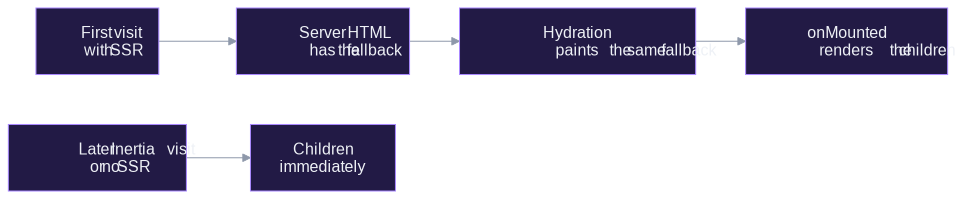
<WhenMounted> is a Vue component from @inertiajs/vue3. It is a mount flag, not a typeof window check. On the first visit the client has to hydrate the server HTML, so the first browser render has to match. Waiting until onMounted keeps both paints identical.
It came from PR #3218 by Evan Burrell, merged on 22 September 2026, and shipped in Inertia 3.8.0 on 1 October 2026. The docs live under Server-side rendering, in a short Client-Only Components section. That is easy to miss if you went looking for a deferred-prop helper.
It is not one. <Deferred> plus Inertia::defer() still load slow data after the first paint. <WhenVisible> plus Inertia::optional() still load props when a block is about to scroll in. <WhenMounted> does not request anything. It only decides when a subtree is allowed to render.
<script setup>
import { WhenMounted } from '@inertiajs/vue3'
import SalesChart from '@/Components/SalesChart.vue'
</script>

<template>
  <WhenMounted>
    <template #fallback>
      <div>Loading chart...</div>
    </template>

    <SalesChart />
  </WhenMounted>
</template>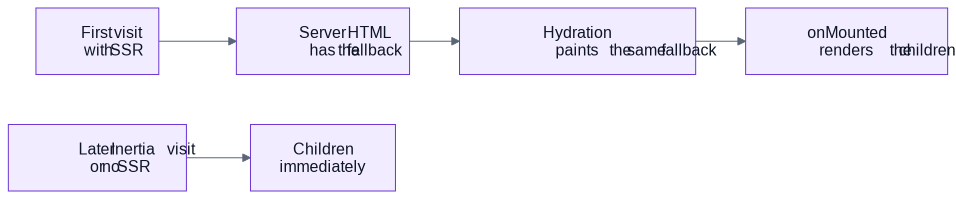
The usual way vs WhenMounted#
The usual fixes are all heavier than they need to be. Turn SSR off for the page and you lose HTML for every block, including the heading you wanted in the first response. Invent a deferred prop so <Deferred> can hide the chart, and you pay an extra HTTP request for something that needs no server data. Rewrite every widget to move window into onMounted, which is the right fix for your code, but not for a third-party chart that reads the viewport while it renders.
The chart runs during SSR, then The chart waits for mount:
<template>
  <h1>{{ stats.title }}</h1>
  <SalesChart :points="stats.points" />
  <!-- setup reads window.innerWidth: the server render throws,
       and the whole page falls back to an empty shell -->
</template><template>
<h1>{{ stats.title }}</h1>
<WhenMounted>
<template #fallback>
<ChartSkeleton />
</template>
<SalesChart :points="stats.points" />
</WhenMounted>
</template>The first visit still server-renders the heading and the skeleton. In the lab, renderToString of a page wrapped in <WhenMounted> contained Loading chart... and not Sales chart. An unwrapped child that read window.innerWidth in setup threw ReferenceError and killed the render.
When the fallback appears#
The Inertia Vue app keeps a hydration flag. It starts false only when the page was server-rendered. <WhenMounted> snapshots that flag when it is created, then sets its own mounted state in onMounted.
| Visit | What you see |
|---|---|
| First load with SSR | Fallback in the server HTML, same fallback during hydration, children after mount |
| Later client-side Inertia visit | Children immediately; the fallback slot does not run |
| App without SSR | Children immediately; the fallback slot does not run |
| No fallback slot | Nothing in the server HTML for that subtree, then the children after mount |
In the lab, a CSR mount (no data-server-rendered attribute) showed Sales chart and rendered the fallback slot zero times. Hydrating the real SSR HTML rendered the fallback once, then replaced it with the chart, and left no leftover fallback node.
Gotcha: It is a mount flag, not a window check
If you gate the chart on typeof window !== 'undefined', the first client render already has window and will paint the children. The server painted the fallback. Vue reports a hydration mismatch. Waiting for mount is the point of the component.
The two ways window still crashes SSR#
<WhenMounted> only skips the default slot. The rest of the page still runs on the server.
A read inside the page’s own <script setup> runs before the template, wrapper or not. In the lab, const width = window.innerWidth at the top of the page threw ReferenceError even with <WhenMounted> around the chart. The pattern in Inertia’s own test page is a function that is only called from the default slot:
<script setup>
import { WhenMounted } from '@inertiajs/vue3'

const clientWidth = () => window.innerWidth
</script>

<template>
  <WhenMounted>
    <template #fallback>
      <div>Loading chart...</div>
    </template>

    <SalesChart :width="clientWidth()" />
  </WhenMounted>
</template>
That clientWidth() call sits in the default slot, so it does not run during renderToString. The same function is fine after mount: a CSR test resolved it to the jsdom path /dashboard.
The other crash is earlier than render. <WhenMounted> does not tree-shake the wrapped component out of the SSR bundle. The module is still imported on the server. A top-level export const viewportWidth = window.innerWidth in the chart file threw on import, before the template ran. Keep the import itself server-safe; only the render needs the browser.
Heads up: React needs a function child
JSX children are built eagerly, so <Chart width={window.innerWidth} /> still runs on the server even inside <WhenMounted>. The React adapter accepts a function: {() => <Chart width={window.innerWidth} />}. Vue slots and Svelte snippets are already lazy, so Vue does not need that form.
WhenMounted, Deferred, or WhenVisible?#
Pick the tool for the problem you actually have.
<WhenMounted> | <Deferred> | <WhenVisible> | |
|---|---|---|---|
| Problem | A widget needs window or document | The data is slow | The block is below the fold |
| Server API | None | Inertia::defer() | Inertia::optional() |
| Extra request | No | Yes, after the first paint | Yes, when the block nears the viewport |
| First HTML | Fallback (and the rest of the page) | Fallback for that block | Fallback for that block |
| Since | Inertia 3.8.0 | Inertia 2 | Inertia 2.0 |
Before 3.8, people sometimes invented a deferred prop just to keep a chart out of the SSR tree. That works visually and costs a round trip. <WhenMounted> is the replacement for that workaround, not a new way to defer data.
Try it yourself#
Confirm the first HTML has the fallback
# with Inertia SSR running
curl -s http://your-app.test/dashboard | grep -o "Loading chart..."
You should see the fallback in the first response, and not the chart’s own markup. Then load the same URL in the browser: after hydration the chart replaces the fallback, with no hydration warning in the console.
Wrap one third-party widget, not the whole page. The heading, the numbers and the layout can still live in the server HTML.
How useful is this?#
| Score | |
|---|---|
| Time saved per use | ★★★★☆ Replaces disabling SSR, or a dummy deferred prop, for one browser-only widget |
| How often you’ll reach for it | ★★★☆☆ Charts, maps, editors, anything that measures the viewport |
| Risk if misused | ★★☆☆☆ A window read in the page setup or at import time still crashes SSR |
| Overall | 4 / 5: the missing piece once you already use SSR and one child cannot |
Recap#
<WhenMounted>keeps Inertia SSR for the page and delays one subtree until it has mounted in the browser. Inertia 3.8.0 and later.- The fallback is for the first server-rendered visit. Later client visits, and apps without SSR, render the children immediately.
- It does not load props and it does not strip the child from the SSR bundle. The import must stay server-safe.
- Keep
windowanddocumentout of the page’s<script setup>and out of top-level module code. A function called only from the default slot is fine.
FAQ#
Which Inertia version added WhenMounted?
Inertia 3.8.0, released 1 October 2026, from PR #3218. It is in the current 3.11.0 Vue adapter. There is no Laravel-side API; inertia-laravel 3.7 does not need a matching change.
Is WhenMounted for deferred props?
No. Use Deferred with Inertia::defer() to load slow data after the first paint, and WhenVisible with Inertia::optional() to load a block as it scrolls in. WhenMounted only delays rendering a subtree that needs the browser.
Why not check typeof window yourself?
On the first client render, window already exists. The children would paint immediately and miss the server HTML, which is the fallback. WhenMounted waits for onMounted so both renders match.
Does it work in an app that is not using SSR?
Yes. Without a server-rendered first visit, the children render immediately and the fallback slot does not run.
Will it keep a heavy chart library out of the SSR bundle?
No. WhenMounted is runtime-only. The wrapped component is still imported on the server, it just is not rendered. Top-level code in that module must be safe to import in Node.
Next steps#
- Server-render a Laravel and Vue Inertia app: the build, the process, and why
windowcrashes the first render - Inertia deferred props in Vue: load slow data after the first paint
- Inertia WhenVisible buffer: load below-the-fold props just before they scroll in
- Inertia docs: client-only components
Sources#
- Inertia v3: Server-side rendering, Client-Only Components
- PR #3218: Add WhenMounted component, merged 22 September 2026
- Inertia v3.8.0, released 1 October 2026
- Source:
packages/vue3/src/whenMounted.tsin 3.11.0 - Tests:
tests/when-mounted.spec.tsandtests/ssr.spec.ts