Your Inertia dashboard shares team settings, a policy reads them, and the controller reads them again. That’s three Redis round trips for the same array, on every page load. Cache::memo()->get('settings') hits the store once and answers the rest from memory.
TL;DR
Cache::memo()->get('settings')hits Redis (or whatever store you wrap) once. The nextgetin the same request returns the in-memory copy. In the lab, three callers needed the same key and the store was hit once.- That in-memory copy is a snapshot.
Cache::put('settings', $new)does not change whatCache::memo()->get('settings')returns. Write throughCache::memo()if you want the memo to forget and reread. - A miss is memoized too. If the first
getreturnsnull, a laterCache::put()in the same request stays invisible toCache::memo(). Cache::memo()->tags(['permissions'])->get(...)has shipped since Laravel 13.33. The tagged value is memoized; resolving the tag id still hits the store on every get.
What Cache::memo() is, and why people miss it#
Cache::memo() is a decorator around any cache store. The first get for a key goes to Redis, the database, the file store, or whatever you passed in. Every later get for that key, in the same request or job, is served from a PHP array.
It arrived in Laravel 12.9.0 on 15 April 2025 (PR #55304, by Tim MacDonald). Every later 12.x and 13.x app already has it. People miss it because “the cache is fast” sounds like enough, and because it lives one heading below remember() in the cache docs. Hitting Redis is cheap. It is not free, and a single Inertia page can do it more times than you think.
The same memo() call optionally takes a store name, so you can decorate Redis even when the default store is something else. Each store gets its own memo. In the lab, Cache::memo('array')->get('name') and Cache::memo('file')->get('name') returned different values for the same key.
use Illuminate\Support\Facades\Cache;

Cache::memo()->get('settings');
Cache::memo('redis')->get('settings');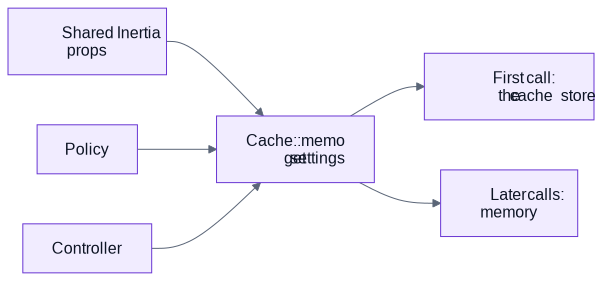
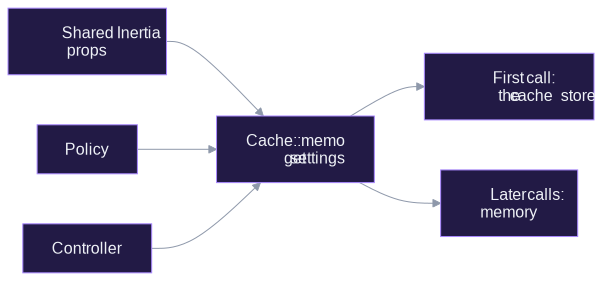
The usual way vs Cache::memo()#
This is the pattern we started with in the lab: three Cache::get calls, three trips to the store.
Cache::get() every time, then Cache::memo()->get():
$settings = Cache::get("team:{$teamId}:settings");

// later, in a policy and in the controller:
$settings = Cache::get("team:{$teamId}:settings");
$settings = Cache::get("team:{$teamId}:settings");
// 3 store hits$settings = Cache::memo()->get("team:{$teamId}:settings");
// later, in a policy and in the controller:
$settings = Cache::memo()->get("team:{$teamId}:settings");
$settings = Cache::memo()->get("team:{$teamId}:settings");
// 1 store hit, then memorymany() is equally careful. After Cache::memo()->get('a'), a follow-up Cache::memo()->many(['a', 'b', 'c']) only fetched b and c from the store. The second many() fetched nothing.
A consistent snapshot for the request#
The performance win is the obvious part. The quieter win is consistency. If another process updates the key, or the TTL expires mid-request, two plain Cache::get() calls can disagree. Cache::memo() will not.
In the lab we stored Taylor, read it through memo(), then wrote Tim with Cache::store(...)->put():
Cache::memo()->get('name')stayedTaylorCache::get('name')was alreadyTim
That is the intended behaviour, not a bug. The first read wins for the rest of the request. If you need the new value, write (or forget) through Cache::memo() so the snapshot is dropped, then get again. A put through memo does not pre-load the new value: the next get hits the store once and memoizes that result. The original PR called this out. We saw the same thing with remember() on a miss: the closure ran, the value was stored, and the following get still paid for one store hit.
Gotcha: Misses are memoized too
Cache::memo()->get('missing') returns null and remembers that miss. A later Cache::put('missing', 'now-there') in the same request does not change what memo()->get('missing') returns. Forget or write through Cache::memo() if the key might appear later in the same request.
Real-world example: a Vue + Inertia dashboard#
Format is not the issue this time. The issue is that three layers of one page all need the same cached array.
use Illuminate\Http\Request;
use Illuminate\Support\Facades\Cache;
use Inertia\Middleware;

class HandleInertiaRequests extends Middleware
{
    public function share(Request $request): array
    {
        $teamId = $request->user()?->team_id;

        return [
            ...parent::share($request),
            'teamSettings' => $teamId
                ? Cache::memo()->get("team:{$teamId}:settings")
                : null,
        ];
    }
}use App\Models\User;
use Illuminate\Support\Facades\Cache;
public function viewAny(User $user): bool
{
$settings = Cache::memo()->get("team:{$user->team_id}:settings");
return (bool) ($settings['invoices.enabled'] ?? false);
}use Illuminate\Support\Facades\Cache;
use Inertia\Inertia;
use Inertia\Response;
public function __invoke(): Response
{
$teamId = auth()->user()->team_id;
$settings = Cache::memo()->get("team:{$teamId}:settings");
return Inertia::render('Dashboard', [
'locale' => $settings['locale'] ?? 'en',
]);
}In the lab, those three memo()->get() calls produced one store hit and the same array each time. Vue just receives teamSettings and locale. It does not need to know a memo exists.
Tags since Laravel 13.33#
Until Laravel 13.33.0 (22 September 2026, PR #61593), Cache::memo() had no tags() method. If you cached permissions or tenant config with tags, you were stuck wrapping a second array store by hand. That now works:
use Illuminate\Support\Facades\Cache;

$permissions = Cache::memo()
    ->tags(['permissions'])
    ->get("permissions:{$user->id}");
The tagged value is memoized. In the lab, a second memo()->tags(['permissions'])->get(...) did not fetch the payload again. It did still read the tag id (tag:permissions:key) from the store, because itemKey() needs the current tag namespace to look the memo up. Flushing the tag dropped both the stored value and the in-memory copy.
Treat that extra tag-id read as cheap. The win is not fetching the payload twice.
once() vs Cache::memo()#
once() memoizes the result of a closure in process memory. It never talks to Redis. Cache::memo() sits in front of a cache store: the value still lives in Redis (with a TTL, tags, and invalidation), and the memo only removes the repeated network hop inside one request or job.
Use once() for a calculation you do not want to cache across requests. Use Cache::memo() when the value is already in the cache and several callers in the same request keep asking for it.
Cache::flexible() is a different layer again: stale-while-revalidate across requests. You can use both. flexible() on a memoized store has been supported since shortly after memo() shipped (PR #55709).
The request and job boundary#
Cache::memo() is registered as a scoped container binding (cache.__memoized:{driver}). A PHP-FPM request already dies at the end, so the memo dies with it. Long-running workers are the interesting case.
Laravel’s queue worker calls forgetScopedInstances() between jobs. In the lab, after we changed the stored value and called app()->forgetScopedInstances(), the next Cache::memo()->get() hit the store and returned the new value. You do not have to flush the memo yourself between jobs.
Tip
If you stash the memo repository on a singleton and reuse it across jobs or Octane requests, you are opting out of that reset. Prefer Cache::memo()->get(...) at the call site.
Cache events follow the same rule as the store hits. The memo repository itself does not fire events. The underlying store does, and only when it is actually called. In the lab, three memo()->get() calls produced one RetrievingKey event.
Try it yourself#
See the snapshot in tinker
use Illuminate\Support\Facades\Cache;

Cache::put('settings', ['theme' => 'dark'], 60);

Cache::get('settings');
Cache::get('settings'); // hits the store again

Cache::memo()->get('settings'); // hits the store
Cache::memo()->get('settings'); // memory

Cache::put('settings', ['theme' => 'light'], 60);
Cache::memo()->get('settings'); // still dark
Cache::get('settings');         // light

Cache::memo()->put('settings', ['theme' => 'light'], 60);
Cache::memo()->get('settings'); // light, and this get hits the store
How useful is this?#
| Score | |
|---|---|
| Time saved per use | ★★★★☆ One decorator removes the repeated store trips on a busy Inertia page |
| How often you’ll reach for it | ★★★★☆ Settings, permissions, feature flags, anything several layers of one request already cache |
| Risk if misused | ★★☆☆☆ A Cache::put() that skips memo leaves a stale snapshot until the request ends |
| Overall | 4.5 / 5: the cheapest way to stop paying for the same cache key twice |
Recap#
Cache::memo()->get($key)hits the store once per request or job. Later gets come from memory.- The memo is a snapshot. Writes must go through
Cache::memo()if later reads should see them. Misses are snapshotted too. Cache::memo()->tags()works from Laravel 13.33. The value is memoized; the tag id is still resolved on each get.once()memoizes a closure.memo()decorates a cache store. Queue workers already reset the scoped memo between jobs.
FAQ#
Which Laravel version added Cache::memo()?
Laravel 12.9.0, on 15 April 2025 (PR #55304). It is in every later 12.x and 13.x release. Tagged memo, Cache::memo()->tags(), shipped in Laravel 13.33.0 on 22 September 2026 (PR #61593).
Is Cache::memo() the same as once()?
No. once() remembers the result of a closure in process memory and never talks to a cache store. Cache::memo() wraps a store so repeated gets in one request skip the network hop but still use that store for TTL, tags and invalidation.
Does Cache::put() update what memo() returns?
Not by itself. Cache::put() writes the store and leaves the memo snapshot alone. Call Cache::memo()->put(), memo()->forget(), or memo()->flush() if later memo() reads in the same request should see the change. The next get after a memo write hits the store once and then memoizes again.
Will the memo leak between queued jobs?
Not if you use Cache::memo() normally. It is a scoped container binding, and the queue worker calls forgetScopedInstances() between jobs. We confirmed that a fresh memo() after that call hits the store again. Do not hold the memo repository on a singleton of your own.
Does memo() work with cache tags?
Yes, from Laravel 13.33. Cache::memo()->tags(['permissions'])->get($key) memoizes the tagged value. Each get still reads the tag id from the store so the memo key can be computed. Flushing the tag drops the in-memory copy as well.
Next steps#
- Cache::flexible: serve stale cache while it refreshes, when the problem is a stampede across requests, not repeated reads in one request
- once() memoization, when the value should never hit a cache store
- Cache::withoutOverlapping() and Cache::funnel(), when the work itself must not run twice
- Laravel docs: cache memoization
Sources#
- Laravel docs: cache memoization
- PR #55304: Introduce memoized cache driver (Laravel 12.9.0, 15 April 2025)
- PR #61593: Tagged memoized cache (Laravel 13.33.0, 22 September 2026)
- PR #55709: Add flexible support to memoized cache store
- Source:
Illuminate\Cache\MemoizedStore - Source:
Illuminate\Cache\CacheManager::memo()