Someone double-clicks “Rebuild report”, and two rebuilds fight over the same table. Or twenty queue workers hit a PDF renderer that falls over at four. You know the fix is a lock, and you know it means a try/catch/finally you’ll copy wrong at least once. Laravel now wraps both cases in one call each.
TL;DR
Cache::withoutOverlapping('reports:rebuild', fn () => ..., lockFor: 120, waitFor: 5)runs the closure under a lock, returns its value and always releases the lock. If it can’t get the lock in time, it throwsLockTimeoutException.Cache::funnel('pdf')->limit(3)->releaseAfter(120)->block(5)->then($run, $busy)lets at most 3 callers in at once. It works on any store with locks, not only Redis. With 6 real processes: no guard ran 6 at once,withoutOverlappingran 1,funnel(3)ran 3.- Always pass
lockFor. The default is0: Redis then never expires the lock, and the database store keeps it for 86,400 seconds. One killed worker blocks the job for a day.
What withoutOverlapping and funnel are, and why people miss them#
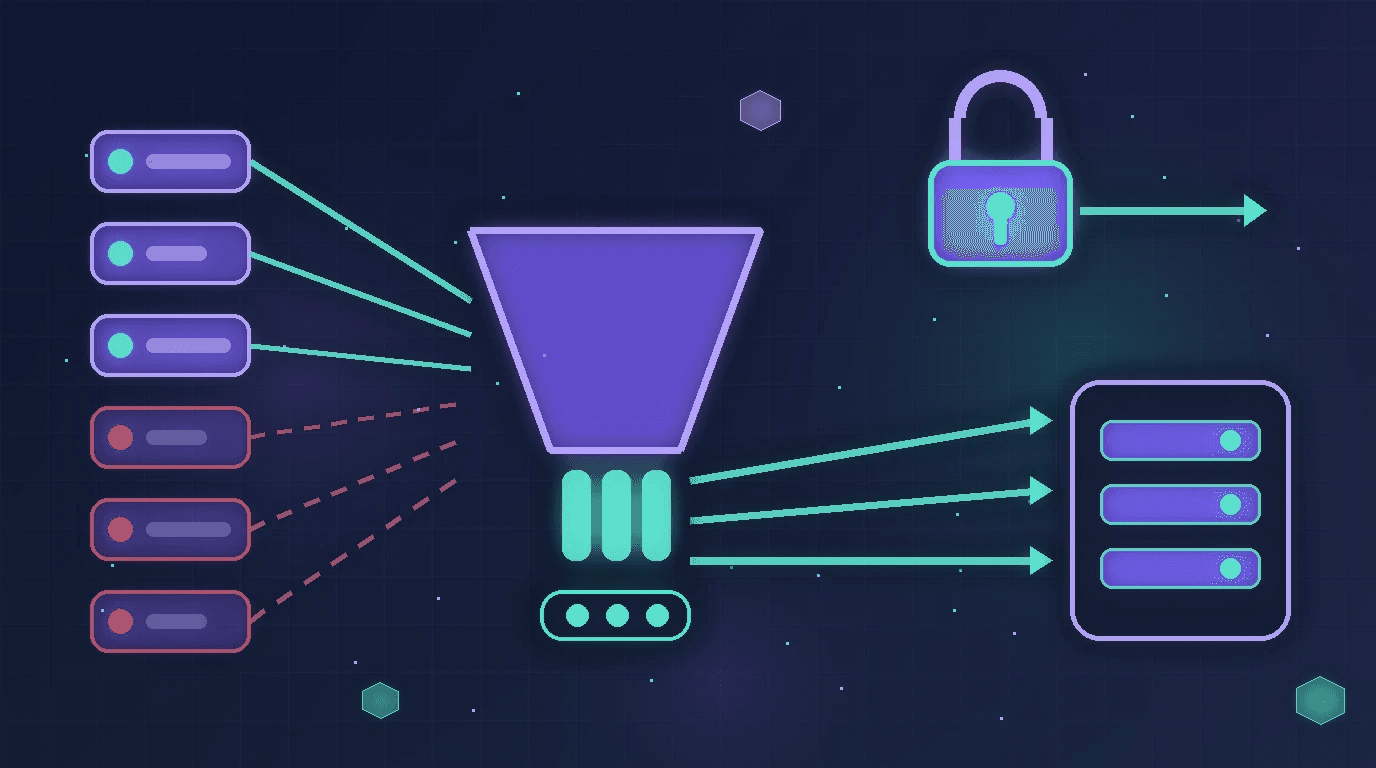
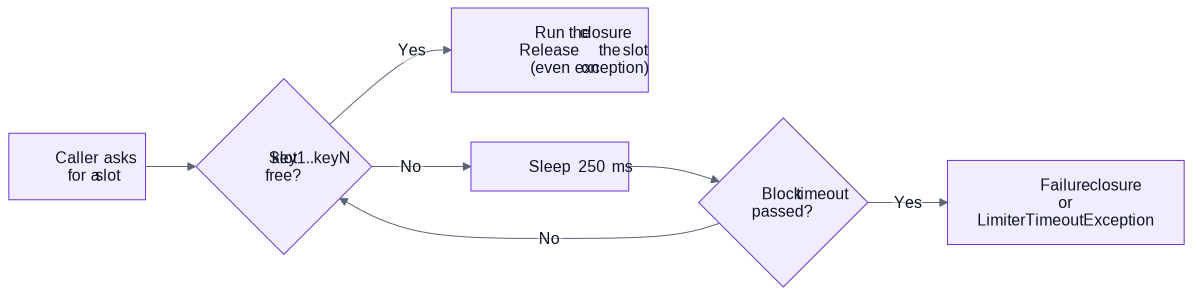
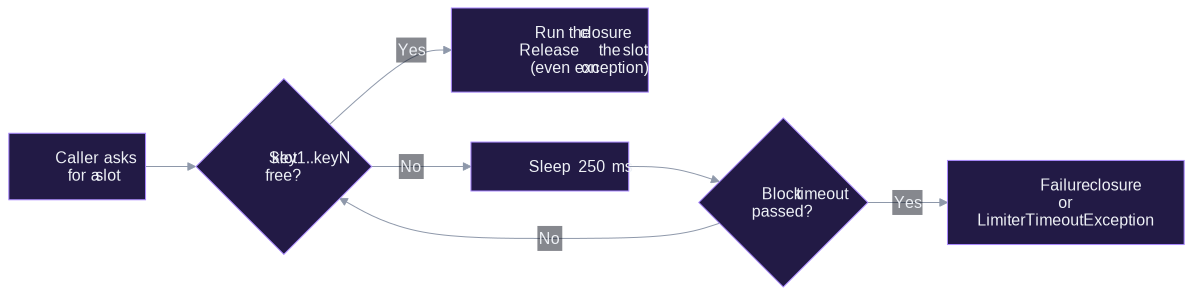
Both are thin wrappers over Laravel’s atomic locks. Cache::withoutOverlapping() is Cache::lock()->block() with a closure, so only one caller runs at a time. Cache::funnel() is a counting lock: it tries slots 1..N and runs your closure in the first free one.
They are recent. withoutOverlapping() shipped in Laravel 12.47 in January 2026 (PR #58303), and enum keys followed in 12.49 (#58444). funnel() shipped in 12.53 in February 2026 (#58439). Both are in every 13.x release.
People miss them because the name sounds familiar. ->withoutOverlapping() on a scheduled task and the WithoutOverlapping job middleware have existed for years, and Redis::funnel() only works on a Redis connection. These two live on the cache facade, work in a controller, a job or a command, and run on the database store your app already has.
The usual way vs withoutOverlapping#
The classic lock code has three jobs: wait for the lock, run the work, release the lock even when the work throws. Here it is next to the gem, both from our lab:
Cache::lock() by hand, then Cache::withoutOverlapping():
use Illuminate\Contracts\Cache\LockTimeoutException;
use Illuminate\Support\Facades\Cache;

$lock = Cache::lock('reports:rebuild', 120);

try {
    $lock->block(5);
    $result = SalesReport::rebuild();
} catch (LockTimeoutException) {
    $result = 'busy';
} finally {
    $lock->release();
}use Illuminate\Contracts\Cache\LockTimeoutException;
use Illuminate\Support\Facades\Cache;
try {
$result = Cache::withoutOverlapping(
'reports:rebuild',
fn () => SalesReport::rebuild(),
lockFor: 120,
waitFor: 5,
);
} catch (LockTimeoutException) {
$result = 'busy';
}The gem returns whatever the closure returns. In the lab, the lock was held inside the closure and free right after. When the closure threw RuntimeException('boom'), the exception reached us and the lock was released anyway.
The arguments are lockFor (seconds the lock lives) and waitFor (seconds to wait for it, default 10). While waiting it retries every 250 ms. waitFor: 0 tries once: in our lab it gave up after 0.1 ms. The key can be a backed enum, so LockKey::ReportRebuild works where you’d pass 'reports:rebuild'.
Cache::funnel(): at most N at a time#
Sometimes one at a time is too strict. Your PDF renderer is happy with 3 parallel jobs, the partner API allows 5 concurrent connections, and the 4th caller should wait or back off.
use Illuminate\Support\Facades\Cache;

return Cache::funnel('pdf-renderer')
    ->limit(3)            // at most 3 at once
    ->releaseAfter(120)   // a slot expires after 120 s if a process dies
    ->block(5)            // wait up to 5 s for a free slot
    ->then(
        fn () => $this->render($invoice),
        fn ($e) => null,  // all slots busy: $e is a LimiterTimeoutException
    );
then() returns the first closure’s value, or the failure closure’s value when no slot frees up. Leave the second closure out and you get an Illuminate\Cache\Limiters\LimiterTimeoutException instead. A slot is freed when the closure throws, too.
Under the hood each slot is a normal cache lock named after the key plus a number. With two funnel calls nested, pdf-renderer1 and pdf-renderer2 were locked and pdf-renderer3 was free. The defaults are releaseAfter(60), block(3) and a 250 ms poll, which you can change with ->sleep(1000).
Redis::funnel() | Cache::funnel() | |
|---|---|---|
| Stores | Redis connection only | Any store with locks: database, file, Redis, Memcached, DynamoDB, array |
| Since | Laravel 5.5 | Laravel 12.53 |
| Typical use | Queue job middleware on Redis | Anywhere, including apps on the database store |
Real processes, real numbers#
Unit tests with the array store prove the logic, not the concurrency. So we started 6 real PHP processes at once with Process::pool(). Each one booted the app, took the guard on the file store, and did 300 ms of fake work.
| Guard | Ran | Most at the same time | Wall time |
|---|---|---|---|
| None | 6 | 6 | ~0.55 s |
withoutOverlapping(lockFor: 30, waitFor: 10) | 6 | 1 | ~2.8–3.0 s |
funnel()->limit(3)->block(10) | 6 | 3 | ~1.0 s |
withoutOverlapping(waitFor: 0) | 1 | 1 | 5 of 6 got “busy” |
The last row is the “don’t queue up, just say no” mode. Five processes got a LockTimeoutException right away and printed “busy”. That’s the behaviour you want behind a button.
Real-world example: a “Rebuild report” button in Vue#
Disabling the button while the request runs stops one double-click. It does nothing about a second tab, a colleague, or the nightly command doing the same rebuild. The lock does.
use App\Actions\SalesReport;
use Illuminate\Contracts\Cache\LockTimeoutException;
use Illuminate\Support\Facades\Cache;
use Inertia\Inertia;

class ReportRebuildController
{
    public function __invoke()
    {
        try {
            Cache::withoutOverlapping(
                'reports:rebuild',
                fn () => SalesReport::rebuild(),
                lockFor: 120,
                waitFor: 0,
            );
        } catch (LockTimeoutException) {
            Inertia::flash('toast', [
                'type' => 'error',
                'message' => 'A rebuild is already running. Try again in a minute.',
            ]);

            return back();
        }

        Inertia::flash('toast', ['type' => 'success', 'message' => 'Report rebuilt.']);

        return back();
    }
}
The Vue page stays boring, which is the point. On the starter kit, the toast flash shows up without extra code (see flash messages):
<script setup lang="ts">
import { useForm } from "@inertiajs/vue3";

const form = useForm({});

function rebuild() {
  form.post("/reports/rebuild", { preserveScroll: true });
}
</script>

<template>
  <button :disabled="form.processing" @click="rebuild">
    {{ form.processing ? "Rebuilding…" : "Rebuild report" }}
  </button>
</template>
In the lab, the first POST flashed toast.type = success. With the lock held by “someone else”, the second POST flashed error, and SalesReport::rebuild() ran exactly once.
Tip: Long rebuild? Lock in the controller, release in the job
If the rebuild is queued, take the lock with Cache::lock('reports:rebuild', 600)->get(), pass $lock->owner() to the job, and release it there with Cache::restoreLock('reports:rebuild', $owner)->release(). withoutOverlapping() is for work that finishes inside the closure.
Real-world example: a queued job that backs off#
For queued work, a busy funnel should not fail the job. Put it back on the queue instead:
use Illuminate\Contracts\Queue\ShouldQueue;
use Illuminate\Foundation\Queue\Queueable;
use Illuminate\Support\Facades\Cache;

class RenderInvoicePdf implements ShouldQueue
{
    use Queueable;

    public function __construct(public int $invoiceId) {}

    public function handle(): void
    {
        Cache::funnel('pdf-renderer')
            ->limit(3)
            ->releaseAfter(120)
            ->block(5)
            ->then(
                fn () => $this->render(),
                fn () => $this->release(10),
            );
    }
}
We tested it with withFakeQueueInteractions(). With all 3 slots held, handle() called release(10) and rendered nothing. After one slot was force-released, the next job rendered and was not released.
Which “without overlapping” do you need?#
Laravel has several tools with similar names. They solve different problems:
| You want | Use |
|---|---|
| A scheduled command never runs twice at once | Schedule::command(...)->withoutOverlapping() |
| Two jobs for the same model never run at once | WithoutOverlapping job middleware |
| Only one copy of a job sits in the queue | ShouldBeUnique |
| One block of code runs once at a time, anywhere | Cache::withoutOverlapping() |
| At most N copies of a block run at once | Cache::funnel() |
Gotchas#
Gotcha: lockFor: 0 means 'until released', and a dead process never releases
withoutOverlapping() defaults to lockFor: 0. RedisLock then sets the key with no expiry at all. The database store falls back to its default timeout: in the lab, cache_locks.expiration was exactly now + 86,400 s. We simulated a worker killed mid-run: the lock still blocked callers at 86,399 s and only freed at 86,400 s. Always pass lockFor, a bit longer than the slowest run. A stuck lock can be cleared with Cache::lock('reports:rebuild')->forceRelease().
Other traps we hit:
- Too short is wrong as well. When the work ran 121 s with
lockFor: 120, a second caller got in. Same for a funnel slot afterreleaseAfter(60). For long loops, takeCache::lock()yourself and call$lock->refresh(). - The
nullcache store hands out locks that never block. NestedwithoutOverlapping()calls on it both ran. If a test or staging env setsCACHE_STORE=null, your guard is gone. - The
arrayandfilestores only lock within one process or one server. Across servers you need a shared store: database, Redis, Memcached or DynamoDB. - Funnel slots are plain locks named key + number, so
funnel('pdf')usespdf1,pdf2, … An unrelatedCache::lock('pdf1')blocked afunnel('pdf')->limit(1)in the lab. Use a distinct key likefunnel:pdf:. funnel()->block()counts whole seconds,withoutOverlapping()counts milliseconds.block(3)gave up after 3 s when it started on a round second, and after 2.25 s when it started at.900.- The exceptions differ:
withoutOverlapping()throwsIlluminate\Contracts\Cache\LockTimeoutException,funnel()throwsIlluminate\Cache\Limiters\LimiterTimeoutException.
Testing it without waiting#
Both helpers wait through Laravel’s Sleep class, so Sleep::fake() skips the waits. Use syncWithCarbon: true, because the timeouts read the clock:
use Illuminate\Contracts\Cache\LockTimeoutException;
use Illuminate\Support\Facades\Cache;
use Illuminate\Support\Sleep;

it('gives up after 5 seconds when a rebuild is running', function () {
    Cache::lock('reports:rebuild', 60)->get();
    Sleep::fake(syncWithCarbon: true);

    expect(fn () => Cache::withoutOverlapping('reports:rebuild', fn () => 1, waitFor: 5))
        ->toThrow(LockTimeoutException::class);

    Sleep::assertSleptTimes(19); // 19 x 250 ms, recorded in under 2 ms
});
For funnel(), this needs Laravel 13.37 or later. PR #62017 made the limiter’s timeout read Carbon instead of time(), so a faked sleep can end it.
Try it yourself#
Watch the second caller bounce
php artisan tinkerCache::lock('demo', 60)->get(); // pretend someone is busy
Cache::withoutOverlapping('demo', fn () => 'ran', lockFor: 10, waitFor: 0);
// LockTimeoutException
Cache::funnel('funnel:demo:')->limit(2)->block(0)->then(fn () => 'ran', fn () => 'busy');
// "ran": the funnel has its own slots
Cache::lock('demo')->forceRelease();
Cache::withoutOverlapping('demo', fn () => 'ran', lockFor: 10, waitFor: 0);
// "ran"How useful is this?#
| Score | |
|---|---|
| Time saved per use | ★★★★☆ One call replaces lock/try/catch/finally, and funnel replaces a hand-built semaphore |
| How often you’ll reach for it | ★★★★☆ Buttons that start heavy work, imports, syncs, rate-limited partners, any app with 2+ workers |
| Risk if misused | ★★★☆☆ Forget lockFor and one crash locks the job for a day |
| Overall | 4.5 / 5: the cheapest race-condition fix in Laravel |
Recap#
Cache::withoutOverlapping($key, $closure, lockFor:, waitFor:)runs once at a time, returns the closure’s value, and always releases the lock.Cache::funnel($key)->limit(N)->releaseAfter()->block()->then($run, $busy)runs at most N at a time on any lock store.- With 6 real processes: no guard ran 6 at once,
withoutOverlapping1,funnel(3)3. - Always set
lockForandreleaseAfter, longer than the slowest run and shorter than “forever”. - Test with
Sleep::fake(syncWithCarbon: true); funnel needs 13.37+ for that.
FAQ#
What is the difference between Cache::withoutOverlapping() and Cache::lock()?
withoutOverlapping() is Cache::lock($key, $lockFor)->block($waitFor, $closure). It waits for the lock, runs the closure, returns its value and releases the lock in a finally block. Use Cache::lock() directly when you need refresh(), owner() or to release the lock in another process.
Does Cache::funnel() need Redis?
No. It works on any cache store that supports locks: database, file, Redis, Memcached, DynamoDB and array. Calling it on a store without locks throws a BadMethodCallException. For several servers, use a shared store such as database or Redis.
What happens if the process dies while holding the lock?
The lock stays until it expires. With the default lockFor of 0, Redis never expires it and the database store keeps it for 86,400 seconds. Always pass lockFor, or clear a stuck lock with Cache::lock($key)->forceRelease().
Which Laravel version do I need?
withoutOverlapping() arrived in Laravel 12.47 and funnel() in 12.53, both in early 2026, and both are in Laravel 13. For tests that fake Sleep with a blocked funnel, use 13.37 or later.
Should I use this or the WithoutOverlapping job middleware?
Use the job middleware when the whole job must not overlap with another job for the same key. Use Cache::withoutOverlapping() or Cache::funnel() for a block of code inside a controller, command or job, or when you need N at a time instead of one.
Next steps#
- Laravel Sleep::fake(), to test the waits in milliseconds
- Queue jobs and HTTP 429, for
release()and backoff on rate-limited APIs - Flash messages in Laravel and Vue, the toast behind the busy message
- Laravel docs: Atomic locks
Sources#
- Laravel docs: Atomic locks and concurrency limiting
- Laravel docs: Preventing job overlaps
- PR #58303: Add
Cache::withoutOverlapping()(Laravel 12.47) - PR #58444: Enum keys in
Cache::flexible()andwithoutOverlapping()(Laravel 12.49) - PR #58439: Add
Cache::funnel()(Laravel 12.53) - PR #62017: Respect faked Sleep in limiter
block()timeout (Laravel 13.37) - Source:
Illuminate\Cache\Repository::withoutOverlapping()andfunnel() - Source:
Illuminate\Cache\Limiters\ConcurrencyLimiter - Source:
Illuminate\Cache\Lock::block()