Your export job polls a slow API with a backoff of 1, 2 and 4 seconds. The code is fine. The test that covers it takes 7 seconds, so somebody marks it ->skip(), and the backoff logic stays untested until it breaks in production. Laravel has had a fix for this since 10.10, and it’s one word: Sleep.
TL;DR
- Write
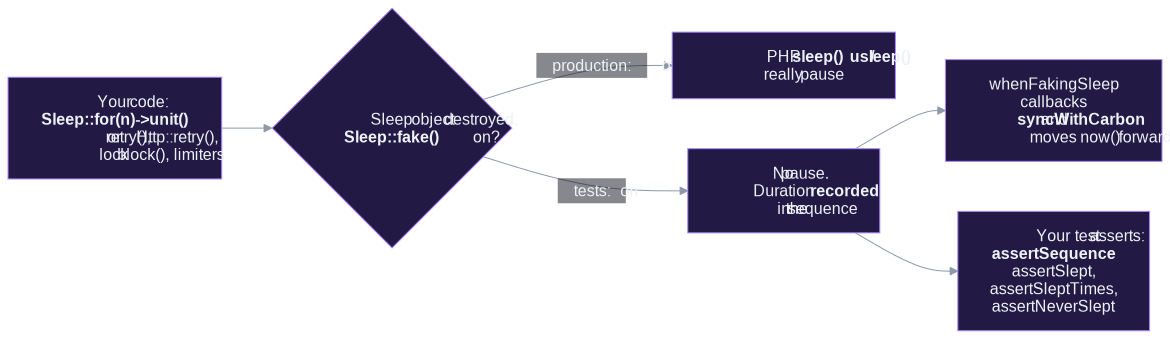
Sleep::for(2)->seconds()instead ofsleep(2). In production it waits exactly the same. - In tests,
Sleep::fake()skips every wait and records it, soSleep::assertSequence([...])can check your backoff. Our poller with 7 s of backoff ran in under 0.5 ms. retry(),Http::retry(),Cache::lock()->block()and the cache/Redis limiters already sleep throughSleep, soSleep::fake()covers them for free.- For anything that measures time (locks,
now()), useSleep::fake(syncWithCarbon: true). With plainfake(), a blocked lock spun over 30,000 times in 750 ms of real time.
What Sleep is and why people miss it#
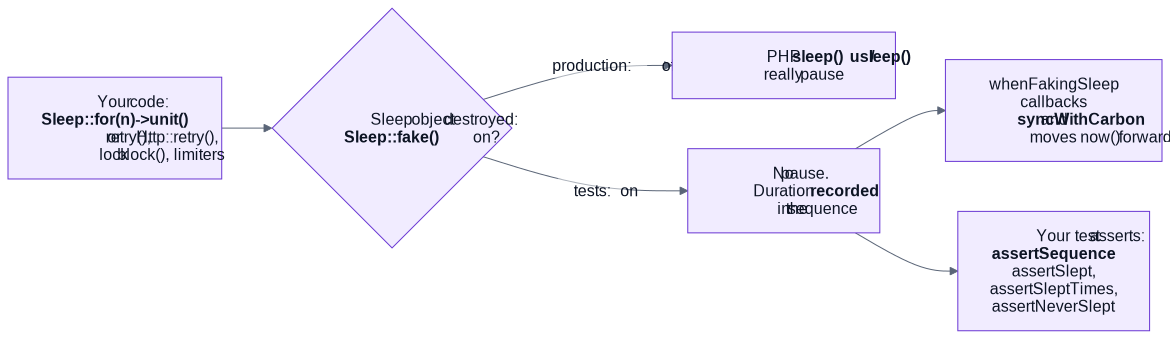
Illuminate\Support\Sleep is a small wrapper around PHP’s sleep() and usleep(). It reads like a sentence and, more importantly, it can be faked:
use Illuminate\Support\Sleep;

Sleep::for(2)->seconds();
Sleep::for(500)->milliseconds();
Sleep::for(1)->second()->and(250)->milliseconds();
Sleep::until(now()->addMinute());
Sleep::sleep(2);      // same as sleep(2)
Sleep::usleep(5000);  // same as usleep(5000)
It shipped in Laravel 10.10 (May 2023, PR #46904) and lives near the bottom of the helpers page, under “Other Utilities”. Nobody scrolls there looking for a testing tool, so most apps still call sleep() and live with slow tests or no tests.
Laravel itself switched to it a long time ago. The retry() helper, Http::retry(), Cache::lock()->block(), Cache::funnel() and the Redis throttle/funnel limiters all pause through Sleep.
The usual way vs Sleep#
Same poller twice: check an export, back off, check again. The left one uses usleep(). The right one uses Sleep with longer, more realistic delays.
usleep(): 600 ms in the test, untestable, then Sleep: 7 s of backoff in 0.42 ms:
public function waitUntilReady(callable $isReady, int $maxChecks = 5): bool
{
    for ($i = 1; $i <= $maxChecks; $i++) {
        if ($isReady()) {
            return true;
        }

        usleep(200_000 * $i); // 200 ms, 400 ms, ...
    }

    return false;
}public function waitUntilReady(callable $isReady, int $maxChecks = 5): bool
{
for ($i = 1; $i <= $maxChecks; $i++) {
if ($isReady()) {
return true;
}
Sleep::for(2 ** ($i - 1))->seconds(); // 1 s, 2 s, 4 s, 8 s
}
return false;
}And the test for the right one:
use Illuminate\Support\Sleep;

it('backs off 1, 2 then 4 seconds before the export is ready', function () {
    Sleep::fake();

    $checks = 0;
    $ready = (new ExportPoller)->waitUntilReady(fn () => ++$checks >= 4);

    expect($ready)->toBeTrue();

    Sleep::assertSequence([
        Sleep::for(1)->second(),
        Sleep::for(2)->seconds(),
        Sleep::for(4)->seconds(),
    ]);
});
The usleep() version waited 600 ms of real time in our lab even with Sleep::fake() on, and Sleep::assertNeverSlept() passed, because the fake never saw it. The Sleep version ran 7 seconds of backoff in 0.42–0.48 ms and proved the exact delays.
sleep() / usleep() | Sleep::for() | |
|---|---|---|
| Production behaviour | waits | waits (same functions underneath) |
| Test speed | real time | instant with Sleep::fake() |
| Can you assert the delays? | no | assertSequence, assertSlept, assertSleptTimes, assertNeverSlept |
Moves now() in tests | no | yes, with syncWithCarbon: true |
| Units | seconds or microseconds, you do the math | minutes, seconds, milliseconds, microseconds, and() |
Real-world example: a flaky carrier API and a rate-limited one#
Exponential backoff with Http::retry()#
A shipping carrier answers 502/503 a few times a day. You retry server errors with growing delays and give up on 4xx right away:
use Illuminate\Http\Client\RequestException;
use Illuminate\Support\Facades\Http;

public function quote(string $zip): array
{
    return Http::baseUrl(config('services.carrier.url'))
        ->timeout(5)
        ->retry(
            [500, 1000, 2000], // ms between attempts
            when: fn ($e) => $e instanceof RequestException && $e->response->serverError(),
        )
        ->get('/rates', ['zip' => $zip])
        ->json();
}
You never wrote Sleep here, and you can still test the backoff, because Http::retry() waits through the retry() helper, which uses Sleep:
it('retries 5xx with backoff', function () {
    Sleep::fake();
    Http::fake(['carrier.example.test/*' => Http::sequence()
        ->push('down', 503)
        ->push('down', 502)
        ->push(['price' => 1290], 200)]);

    expect((new CarrierRates)->quote('10115'))->toBe(['price' => 1290]);

    Sleep::assertSequence([
        Sleep::for(500)->milliseconds(),
        Sleep::for(1)->second(),
    ]);
    Http::assertSentCount(3);
});

it('does not retry a 422', function () {
    Sleep::fake();
    Http::fake(['carrier.example.test/*' => Http::response('bad zip', 422)]);

    expect(fn () => (new CarrierRates)->quote('nope'))->toThrow(RequestException::class);

    Sleep::assertNeverSlept();
    Http::assertSentCount(1);
});
The first test covers 1.5 s of waiting and finished in about 15 ms. The second one is the test people usually forget: it proves you don’t hammer an API that already told you the input is wrong.
Honouring Retry-After from a 429#
An accounting API returns 429 with Retry-After: 30. You wait what it asks, then try again:
public function push(array $invoice): int
{
    $attempts = 0;

    while (true) {
        $attempts++;
        $response = Http::post(config('services.books.url').'/invoices', $invoice);

        if ($response->status() !== 429 || $attempts >= 3) {
            return $response->status();
        }

        Sleep::for((int) $response->header('Retry-After') ?: 1)->seconds();
    }
}use Carbon\CarbonInterval;
it('waits exactly as long as Retry-After says', function () {
Sleep::fake();
Http::fake(['books.example.test/*' => Http::sequence()
->push('slow down', 429, ['Retry-After' => '30'])
->push(['id' => 7], 201)]);
expect((new InvoiceSync)->push(['total' => 99]))->toBe(201);
Sleep::assertSlept(fn (CarbonInterval $d) => $d->totalSeconds == 30, times: 1);
});A 30-second test became an instant one, and it checks the number you actually care about.
Pro tip: Inside queue jobs, release instead of sleeping for long waits
Sleep blocks the worker for the whole wait. For a few hundred milliseconds that’s fine. For Retry-After: 30 inside a job, prefer $this->release(30) so the worker picks up other jobs meanwhile. Keep Sleep for short, in-process waits and for commands.
The rest of the API, in one place#
// Return a value after sleeping
Sleep::for(2)->seconds()->then(fn () => 'done'); // 'done'

// Skip the sleep conditionally
Sleep::for(5)->seconds()->when($shouldWait);
Sleep::for(5)->seconds()->unless(app()->runningUnitTests());

// Count, filter or rule out sleeps
Sleep::assertSleptTimes(3);
Sleep::assertSlept(fn (CarbonInterval $d) => $d->totalSeconds >= 30, times: 1);
Sleep::assertNeverSlept();
Sleep::assertInsomniac(); // sleeps happened, but all of them were 0

// React to each fake sleep
Sleep::whenFakingSleep(fn (CarbonInterval $d) => $log[] = $d->totalMilliseconds); // [1250.0]

// Keep now() moving with the fake clock
Sleep::fake(syncWithCarbon: true);
Each of these is covered by a test in our lab. Sleep::for(90)->seconds() with syncWithCarbon: true moved a frozen now() by exactly 90 seconds, and Sleep::until(now()->addSeconds(3)) recorded a 3-second sleep.
Gotchas#
A number without a unit throws, late. Sleep::for(500) with no ->milliseconds() doesn’t fail on that line. It throws RuntimeException: Unknown duration unit. when the object is destroyed. Always finish the chain with a unit.
The sleep happens on destruct, not on that line. Sleep waits in __destruct(). A bare Sleep::for(1)->second(); statement is destroyed at once, so it behaves as you expect. But keep it in a variable and the wait moves:
$pause = Sleep::for(1)->second(); // nothing yet
$this->info('next line');         // runs first
unset($pause);                    // the second passes here
Our test recorded ['next line', 'slept']. Don’t store Sleep objects; use ->then() if you want a value back.
Native sleep() is invisible to the fake. Packages and older code that call sleep() or usleep() still wait in your tests, and assertNeverSlept() happily passes. The queue worker’s own idle sleep is native too, which is fine: you don’t test that.
Gotcha: Cache locks and limiters measure time, so fake the clock too
Cache::lock('report')->block(1) sleeps through Sleep, but it decides when to give up by reading now(). With plain Sleep::fake(), the waits are skipped and the clock doesn’t move, so the loop spins until real time runs out. In our lab it looped 30,000–36,000 times in 750 ms (it varies per run) before throwing LockTimeoutException.
With Sleep::fake(syncWithCarbon: true) (and freezeTime()), the same test threw after 3 fake 250 ms sleeps in under 1 ms. Laravel 13.37 made Cache::funnel() and the Redis limiters’ block() measure time the same way (PR #62017), so the same rule applies to them: when the code under test checks the clock, sync it.
The fake resets between tests. Laravel’s TestCase calls Sleep::fake(false) in teardown, so one faked test can’t leak into the next. Plain PHPUnit tests that don’t extend Laravel’s TestCase don’t get that cleanup.
Try it yourself#
Find the sleeps your tests can't see
grep -rnE "\b(u)?sleep\(" app/ --include=*.php | grep -v "Sleep::"Swap each hit for Sleep::for(...)->seconds() or ->milliseconds(), add Sleep::fake() to the test, and assert the sequence. Then run php artisan test --profile before and after to see which tests got faster.
How useful is this?#
| Score | |
|---|---|
| Time saved per use | ★★★★★ Seconds per test, minutes per CI run on retry-heavy suites |
| How often you’ll reach for it | ★★★★☆ Any retry, backoff, polling, rate-limit or lock code |
| Risk if misused | ★★☆☆☆ Missing units and stored objects fail loudly; locks need syncWithCarbon |
| Overall | 4.5 / 5: a one-word change that turns slow, skipped tests into fast, precise ones |
Recap#
- Write
Sleep::for(n)->seconds()instead ofsleep(n); production behaviour stays the same. Sleep::fake()skips every wait and records it; check it withassertSequence()orassertSlept().retry(),Http::retry(), cache locks and limiters already useSleep, so their backoff is testable today.- Use
Sleep::fake(syncWithCarbon: true)when the code reads the clock, likeCache::lock()->block(). - Always add a unit, and don’t keep
Sleepobjects in variables.
FAQ#
Which Laravel version has the Sleep class?
Laravel 10.10 (May 2023, PR #46904). when()/unless() and whenFakingSleep() came later in 10.x, and syncWithCarbon in 10.48. We tested on Laravel 13.40.
Does Sleep::fake() also fake PHP sleep() and usleep()?
No. It only affects code that goes through the Sleep class. Native calls still pause and are not recorded, so assertNeverSlept() can pass while your test waits.
How do I test Http::retry() backoff without waiting?
Call Sleep::fake() before the request. Http::retry() waits through the retry() helper, which uses Sleep, so Sleep::assertSequence([Sleep::for(500)->milliseconds(), ...]) checks every delay.
Why does my lock block() test still take a second with Sleep::fake()?
The lock decides when to give up by reading the clock, and plain fake() does not move it, so the loop spins in real time. Use Sleep::fake(syncWithCarbon: true), ideally with freezeTime().
Should I use Sleep inside queued jobs?
For short waits, yes. For long ones like a 30-second Retry-After, release the job with $this->release(30) so the worker is free in the meantime.
Next steps#
- Testing with Http::fake(), for the request side of these tests
- Http::pool(), when you want calls to overlap instead of wait
- Testing a Laravel + Vue app, to fit these tests into your suite
- Laravel docs: Sleep
Sources#
- Laravel 13 docs: Helpers, Sleep and Testing Sleep
- laravel/framework PR #46904: Add the Sleep class (Laravel 10.10)
- laravel/framework PR #46963: Improve Sleep assertions
- laravel/framework PR #47228: Sleep testing hooks (whenFakingSleep)
- laravel/framework PR #50392: Sleep syncing with Carbon (Laravel 10.48)
- laravel/framework PR #62017: Respect faked Sleep in limiter block() timeout (Laravel 13.37)
- Source:
Illuminate\Support\Sleep - Source:
retry()helper - Laravel 13 docs: queue job release