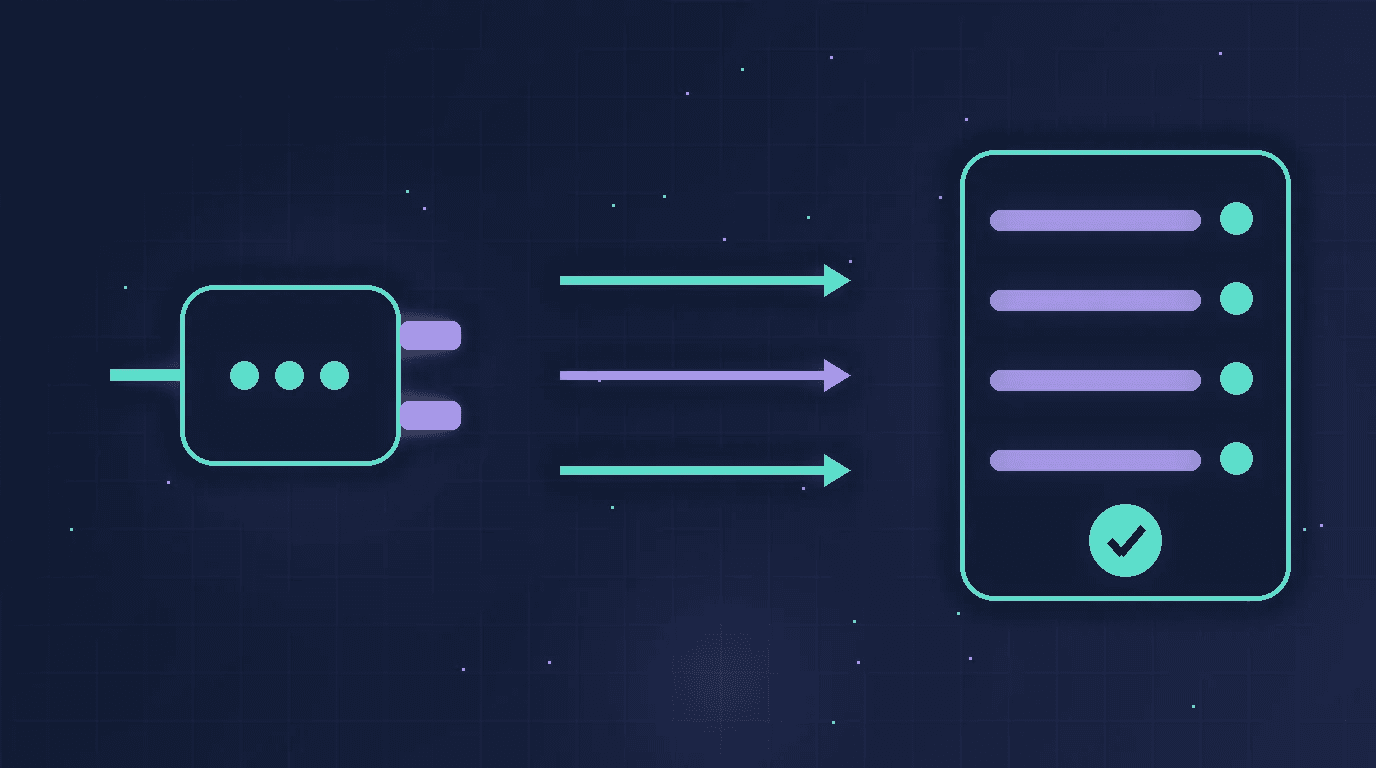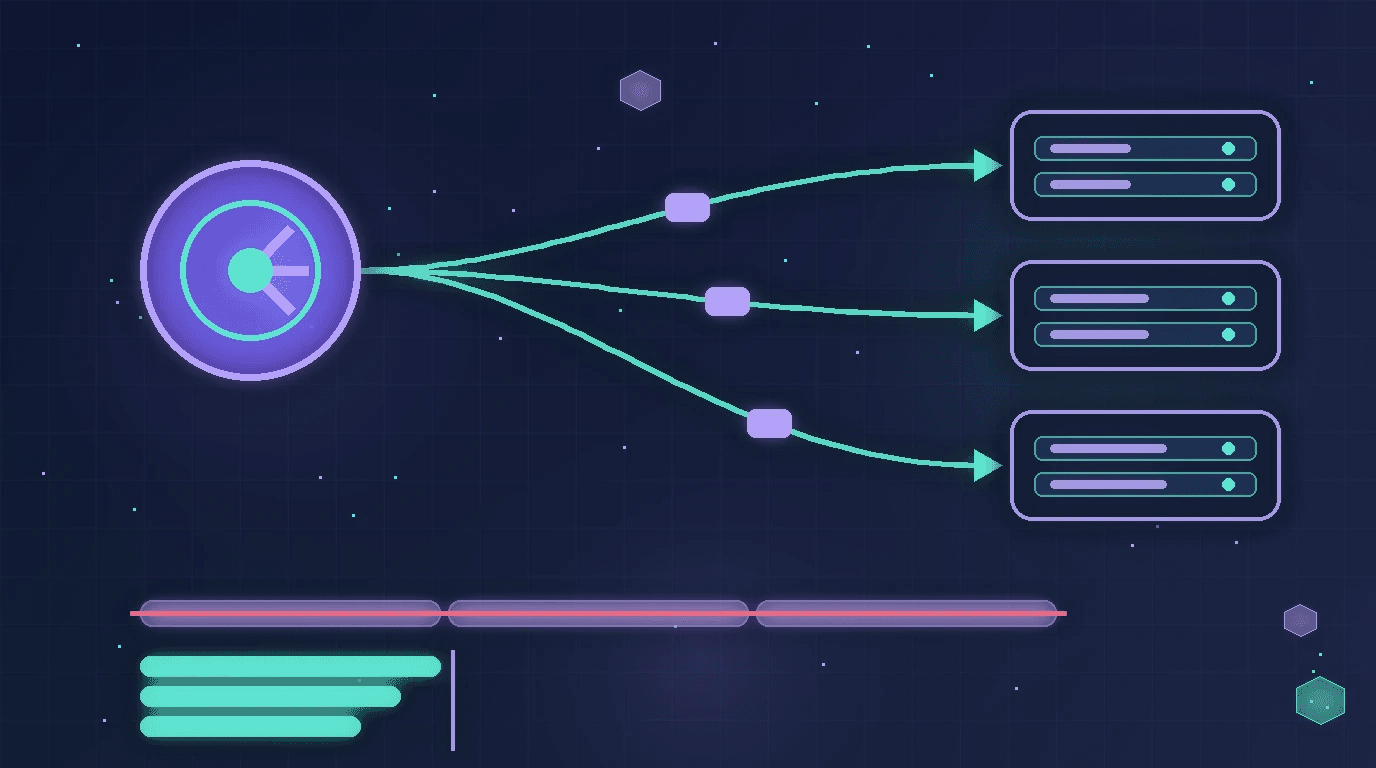
Your checkout asks three shipping carriers for a rate. Each answers in about half a second, and your controller asks them one after another, so the customer waits a full 1.5 seconds before seeing a price. Laravel’s HTTP client can send all three at once with one method, and it has been there since Laravel 8.
TL;DR
Http::pool(fn (Pool $pool) => [...])sends every request at the same time and waits for the slowest one. Three 500 ms calls took 504 ms in our lab instead of 1,507 ms.- Name requests with
$pool->as('billing'), and cap parallel requests withconcurrency: 5when an API rate-limits you. - Failures don’t throw. A timeout or dead host comes back as a
ConnectionExceptioninside the results array, so check each entry before calling->json(). - On Laravel 13 the results come back in the order requests finish, and
Http::withHeaders()->pool()silently drops your headers. Configure each request inside the pool.
What Http::pool() is and why most people miss it#
Http::pool() takes a closure, collects the requests you add to the Pool, and fires them together through Guzzle’s curl multi handle. It returns an array of responses once the last one is done:
use Illuminate\Http\Client\Pool;
use Illuminate\Support\Facades\Http;

$responses = Http::pool(fn (Pool $pool) => [
    $pool->get('https://billing.example.test/mrr'),
    $pool->get('https://shipping.example.test/late-orders'),
    $pool->get('https://support.example.test/open-tickets'),
]);

$mrr = $responses[0]->json('value');
It arrived in Laravel 8.37 (April 2021, PR #36948), and it sits in the HTTP client docs under “Concurrent Requests”, well below the Http::get() examples everyone copies. Most code reviews never ask “could these three calls run at once?”, so the sequential version ships and stays.
It kept growing since: Http::batch() with progress callbacks in 12.32, a concurrency limit in 12.36 that actually caps in-flight requests since 12.42, a new default in 13.0, and a batch() fix for retry()/throw() failures in 13.39 (PR #62120).


The usual way vs Http::pool()#
We pointed both versions at a local API that sleeps 500 ms per call.
one after another: 1,507 ms, then Http::pool(): 504 ms:
$billing = Http::timeout(3)->get($billingUrl);
$shipping = Http::timeout(3)->get($shippingUrl);
$support = Http::timeout(3)->get($supportUrl);

return [
    'mrr' => $billing->json('value'),
    'late' => $shipping->json('value'),
    'tickets' => $support->json('value'),
];$r = Http::pool(fn (Pool $pool) => [
$pool->as('billing')->timeout(3)->get($billingUrl),
$pool->as('shipping')->timeout(3)->get($shippingUrl),
$pool->as('support')->timeout(3)->get($supportUrl),
]);
return [
'mrr' => $r['billing']->json('value'),
'late' => $r['shipping']->json('value'),
'tickets' => $r['support']->json('value'),
];The time you wait drops from the sum of the calls to the slowest call. With eight 400 ms calls the gap gets silly: 404 ms pooled, with all eight in flight at once.
Sequential Http::get() | Http::pool() | Concurrency::run() | Queue job per call | |
|---|---|---|---|---|
| Runs calls at the same time | no | yes | yes | yes |
| Extra cost | none | none (one PHP process) | about 200 ms to boot child processes | a worker and a round trip |
| Good for | one call | many HTTP calls in one request | slow PHP work: queries, CPU | work the user doesn’t wait for |
| Result | Response or exception thrown | array of Response or exception | array of return values | nothing, until you store it |
If your slow work is HTTP, the pool is the cheapest way to parallelize it. Our Concurrency::run() post covers the case where the slow part is database queries or PHP code.
Named requests, loops and concurrency#
$pool->as('name') keys the result by name. The closure doesn’t even have to return anything, so building a pool in a loop is fine:
$responses = Http::pool(function (Pool $pool) use ($orderIds) {
    foreach ($orderIds as $id) {
        $pool->as("order-{$id}")->get("https://shop.example.test/orders/{$id}");
    }
}, concurrency: 5);
concurrency: 5 keeps at most five requests in flight and starts the next one when a slot frees up. In the lab, eight 400 ms calls with concurrency: 2 took 1,613 ms and the server never saw more than two at once. Use it for APIs with rate limits or for pools of hundreds of URLs.
Real-world example: shipping quotes in an Inertia checkout#
Four carriers, each with its own token. One is slow, one returns a 500, one is down. The page must still show the quotes that worked, cheapest first, and log the rest.
namespace App\Services;

use Illuminate\Http\Client\Pool;
use Illuminate\Http\Client\Response;
use Illuminate\Support\Facades\Http;
use Illuminate\Support\Facades\Log;

class ShippingQuotes
{
    public function for(array $parcel): array
    {
        $carriers = config('shipping.carriers'); // ['name' => ['url' => ..., 'token' => ...]]

        $responses = Http::pool(function (Pool $pool) use ($carriers, $parcel) {
            foreach ($carriers as $name => $carrier) {
                $pool->as($name)
                    ->withToken($carrier['token'])
                    ->timeout(3)
                    ->retry(2, 200, throw: false)
                    ->post($carrier['url'], $parcel);
            }
        });

        return collect($responses)
            ->each(function ($response, string $carrier) {
                if (! $response instanceof Response || $response->failed()) {
                    Log::warning("Shipping quote failed: {$carrier}", [
                        'error' => $response instanceof \Throwable ? $response->getMessage() : $response->status(),
                    ]);
                }
            })
            ->filter(fn ($response) => $response instanceof Response && $response->successful())
            ->map(fn (Response $response, string $carrier) => [
                'carrier' => $carrier,
                'price' => $response->json('price'),
                'days' => $response->json('days'),
            ])
            ->sortBy('price')
            ->values()
            ->all();
    }
}
Now the Inertia part. Wrap the quotes in Inertia::defer() so the checkout paints first and the quotes arrive in a follow-up request:
public function show(Request $request, ShippingQuotes $quotes): Response
{
    $cart = $request->user()->cart;

    return Inertia::render('Checkout', [
        'cart' => $cart->toSummary(),
        'quotes' => Inertia::defer(fn () => $quotes->for($cart->parcel())),
    ]);
}<script setup lang="ts">
import { Deferred } from '@inertiajs/vue3'
defineProps<{
cart: { items: number }
quotes?: { carrier: string; price: number; days: number }[]
}>()
</script>
<template>
<Deferred data="quotes">
<template #fallback>
<p>Asking the carriers…</p>
</template>
<ul>
<li v-for="quote in quotes" :key="quote.carrier">
{{ quote.carrier }}: {{ quote.price }} ({{ quote.days }} days)
</li>
</ul>
</Deferred>
</template>We ran this exact service in a Pest test with four fake carriers: 600 ms, 400 ms, a 500 error and a dead port. The first Inertia request returned in 10 ms without the quotes prop. The deferred request came back in 607 ms with two quotes, cheapest first, and two warnings in the log. Sequentially, the same carriers would cost more than a second, plus the retry.
Gotchas#
Gotcha: On Laravel 13, results arrive in completion order
The keys are right, but the array order is the order requests finished. We sent calls of 400 ms, 50 ms and 200 ms:
array_keys($responses); // [1, 2, 0]$responses[0] is still the first request, so index and name lookups (and [$a, $b] = $responses) are safe. But foreach position, array_values(), array_combine($ids, $responses) or collect($responses)->values() now pair data with the wrong request. Call ksort($responses) first, or use names.
Why it changed: Laravel 13.0 switched the default concurrency from null to 0, which means “all at once” (PR #57972). The old null path still exists and waits in definition order: passing concurrency: null in our lab gave [0, 1, 2] in 403 ms. Http::batch() always returns definition order.
Config on Http:: before pool() is silently dropped. Http::withHeaders(['X-Tenant' => 'acme'])->withToken('secret')->pool(...) sent neither the header nor the token in our test. Each request in the pool starts fresh. The docs say it, and nothing warns you at runtime. Put the config on each request, or share it with a PendingRequest macro:
use Illuminate\Http\Client\PendingRequest;

PendingRequest::macro('crm', function () {
    return $this->baseUrl(config('services.crm.url'))
        ->withToken(config('services.crm.token'))
        ->timeout(3);
});

// $pool->as('contacts')->crm()->get('/contacts');
// Http::crm()->get('/contacts'); also works outside a pool
Failures are values, not exceptions. A dead host or a timeout gives you a ConnectionException in the array. Calling ->json() on it is a fatal Error, not a nice HTTP exception. A 4xx or 5xx is a normal Response with failed() === true, unless you add ->throw(), which turns it into a RequestException in the array.
retry() works per request. $pool->retry(3, 100)->get(...) retried our flaky endpoint and got a 200 on the third try. With throw: false, an endpoint that never recovers comes back as its last failed Response. There is no pool-wide retry(): proposals for one (#61537) and for pool-level defaults (#61562) were closed.
Tests: fake as usual. Http::fake(), assertSent() and assertSentCount() work with pooled requests. With Http::preventStrayRequests(), an unfaked pooled request doesn’t throw. It shows up as a StrayRequestException in the results array, so assert on it.
Heads up: Need callbacks? Use Http::batch()
Http::batch() (Laravel 12.32+) takes the same closure and adds before, progress, catch, then and finally hooks, like Bus::batch(). then only runs when every request succeeded. ->defer() sends the whole batch after the response:
Http::batch(fn (Batch $batch) => [
    $batch->as('products')->get($productsUrl),
    $batch->as('prices')->get($pricesUrl),
    $batch->as('stock')->get($stockUrl),
])->catch(fn (Batch $batch, int|string $key, $failure) => Log::warning("Catalog sync failed: {$key}"))
  ->then(fn (Batch $batch, array $results) => CatalogImported::dispatch($results))
  ->concurrency(2)
  ->send();
With one request returning 500, our log read catch:b:500, progress:c, progress:a, finally:failed=1, and then never ran. Before 13.39, a request that failed after retry() counted as a success and skipped catch(). On 13.39 it reached catch() as a RequestException.
Try it yourself#
Time it against a slow public endpoint
use Illuminate\Http\Client\Pool;
use Illuminate\Support\Facades\Artisan;
use Illuminate\Support\Facades\Http;

Artisan::command('pool:check', function () {
    $url = 'https://httpbin.org/delay/1';

    $start = microtime(true);
    foreach (range(1, 3) as $i) {
        Http::get($url);
    }
    $this->info('One by one: '.round(microtime(true) - $start, 1).'s');

    $start = microtime(true);
    Http::pool(fn (Pool $pool) => [
        $pool->get($url),
        $pool->get($url),
        $pool->get($url),
    ]);
    $this->info('Pooled:     '.round(microtime(true) - $start, 1).'s');
});php artisan pool:check
# One by one: 7.5s
# Pooled: 2.4sYour numbers depend on your network; the gap is what matters. Then search your app for two Http:: calls in a row that don’t use each other’s result. Each pair is a candidate.
How useful is this?#
| Score | |
|---|---|
| Time saved per use | ★★★★★ The wait drops from the sum of the calls to the slowest one |
| How often you’ll reach for it | ★★★★☆ Dashboards, checkouts, syncs, webhooks fan-out, scrapers |
| Risk if misused | ★★★☆☆ Completion order, dropped headers, unchecked exceptions |
| Overall | 4.5 / 5: no package, no workers, and the speedup shows up on the first request |
Recap#
Http::pool()sends outgoing requests at the same time; you wait for the slowest one, not the sum.- Name requests with
as(), cap them withconcurrency:, and configure each request inside the pool. - Every entry is a
Responseor an exception: checkinstanceof Responseandsuccessful()before reading it. - On Laravel 13 the array is in completion order. Use names or
ksort(), notforeachposition. - Reach for
Http::batch()when you needprogress/catch/thencallbacks ordefer().
FAQ#
Which Laravel version has Http::pool()?
Laravel 8.37 (April 2021, PR #36948). The concurrency argument arrived in 12.36 and limits in-flight requests properly since 12.42. Laravel 13.0 changed the default to send every request at once. We tested on 13.39.
Is Http::pool() real parallelism?
It is concurrent I/O in one PHP process: curl sends all requests and waits on the network for all of them together. Your PHP code is not run in parallel. For CPU or database work, use Concurrency::run() instead.
Why did Http::withHeaders()->pool() not send my headers?
Each request in the pool is built fresh, so options set on the outer Http:: call are ignored. Set them on each $pool->... request, or share them with a PendingRequest macro.
How do I handle a timeout in a pool?
Nothing is thrown. The entry for that request is a ConnectionException. Check $response instanceof Response before calling ok() or json(), and log or skip the rest.
What is the difference between Http::pool() and Http::batch()?
pool() returns the array of results and that is all. batch() (12.32+) adds before, progress, catch, then and finally callbacks, counters like failedRequests, concurrency() and defer(), and always returns results in definition order.
Next steps#
- Concurrency::run(), when the slow part is PHP or the database
- The defer() helper, for calls the user doesn’t need to wait for
- Testing with Http::fake(), to cover the failure paths above
- Laravel docs: concurrent requests
Sources#
- Laravel 13 docs: HTTP client, concurrent requests
- laravel/framework PR #36948: Handle concurrent asynchronous requests in the HTTP client (Laravel 8.37)
- laravel/framework PR #56946: Add Http::batch (Laravel 12.32)
- laravel/framework PR #57555: Concurrency control for Http::pool and Http::batch (Laravel 12.36)
- laravel/framework PR #57973: Fix pool() and batch() concurrency (Laravel 12.42)
- laravel/framework PR #57972: Default pool() concurrency in 13.x
- laravel/framework PR #62120: Fix Http::batch() treating retry() and throw() failures as successes (Laravel 13.39)
- Source:
PendingRequest::pool() - Inertia docs: deferred props