
You want a signup field that accepts an email or a handle. So you write a regex, or a closure that runs two validators, and a typo in either one lets ab through. Laravel already has a rule for this: Rule::anyOf().
TL;DR
Rule::anyOf([['string', 'email'], ['string', 'alpha_dash', 'min:6']])passes if the value is a valid email, or a handle of at least 6 letters, numbers, dashes or underscores. Every rule inside a set must pass; one matching set is enough.- Put
requirednext toanyOf, not inside the sets. An empty string skipsanyOfbecause the rule is not implicit, so''would otherwise pass. - Failures report a single message,
The :attribute field is invalid., on the field itself. Nested object shapes do not put errors onpayment.last4. Customize it withusername.any_of. - It shipped in Laravel 12.8 (April 2025, PR #55191) and is in every 13.x release. Use 13.39 or later so an associative array such as
username[x]=1cannot sneak past a plain ruleset list.
What Rule::anyOf() is, and why people miss it#
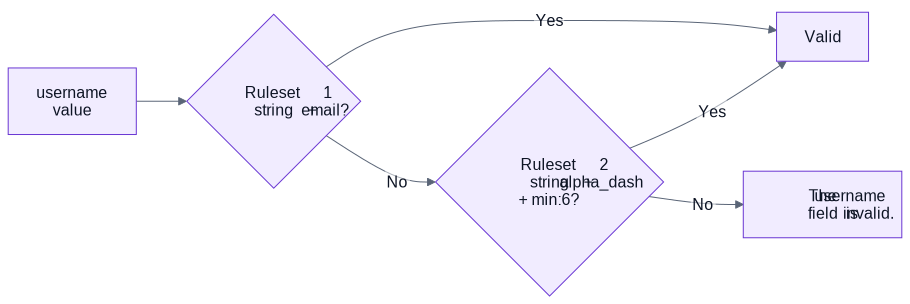
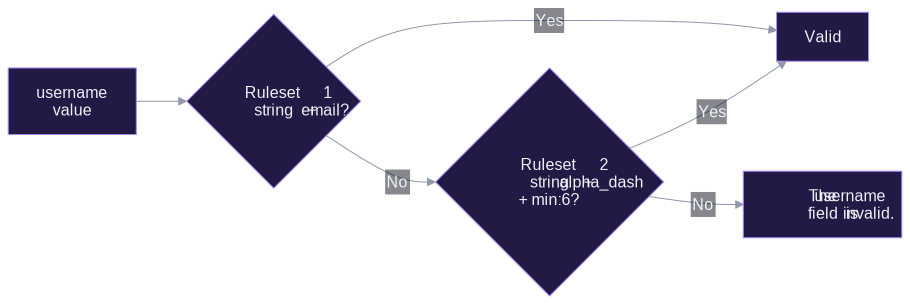
Rule::anyOf() takes an array of rulesets and asks: does this value fully satisfy any one of them? The first set that passes wins. If none do, the field is invalid.
The official docs use a username that may be an email or a handle:
use Illuminate\Validation\Rule;

'username' => [
    'required',
    Rule::anyOf([
        ['string', 'email'],
        ['string', 'alpha_dash', 'min:6'],
    ]),
],
It arrived in Laravel 12.8.0 on 8 April 2025 (PR #55191), so every 13.x app already has it. People miss it because the need shows up as “email or phone” and the habit is a regex or a custom closure, and because the docs file it under the long list of available rules, after after_or_equal and before alpha.
The same rule also accepts associative rulesets. Those treat the value as an object and validate its keys, which is how you describe a payment that is either a card or a bank transfer.
The usual way vs Rule::anyOf()#
The closure below is what we had in the lab before switching. It is correct, and it is also two extra validators and a message you have to write yourself:
A custom closure running two validators, then Rule::anyOf():
'username' => [
    'required',
    function (string $attribute, mixed $value, Closure $fail) {
        $email = Validator::make(['v' => $value], ['v' => 'email'])->passes();
        $handle = Validator::make(['v' => $value], ['v' => 'alpha_dash|min:6'])->passes();

        if (! $email && ! $handle) {
            $fail('The '.$attribute.' field is invalid.');
        }
    },
],use Illuminate\Validation\Rule;
'username' => [
'required',
Rule::anyOf([
['string', 'email'],
['string', 'alpha_dash', 'min:6'],
]),
],In the lab, taylor@laravel.com and my_user passed both versions and validated() returned the same array. ab failed: it is alpha_dash, but it is not 6 characters and it is not an email. not an email failed both sets. The @ in an email would fail alpha_dash on its own; that does not matter, because the email set already passed.
You can write a ruleset as a pipe string as well: Rule::anyOf(['email', 'uuid']) accepted ana@example.com and a v4 UUID, and rejected abc.
Nested rule arrays: card or bank#
When a ruleset is an associative array, anyOf validates the value as an object against those keys. That is the tagged-union case: one field, two shapes, a type that picks which other keys are required.
use Illuminate\Validation\Rule;

'payment' => [
    'required',
    'array',
    Rule::anyOf([
        [
            'type' => ['required', 'in:card'],
            'last4' => ['required', 'digits:4'],
        ],
        [
            'type' => ['required', 'in:bank'],
            'iban' => ['required', 'string', 'min:15'],
        ],
    ]),
],
['type' => 'card', 'last4' => '4242'] passed, and so did a bank payload with a long IBAN. ['type' => 'card', 'last4' => '42'] failed, and so did a card that only sent an IBAN. The error sat on payment, not on payment.last4.
You can nest Rule::anyOf() inside those keys. In the lab, a user object whose id was either an email or an integer passed with id set to ana@example.com or 7, and failed with id set to nope. The message was still The user field is invalid.
Real-world example: a Vue + Inertia signup form#
The rules above belong in a form request. The message is the part the Vue page will show, so write one a person can act on:
use Illuminate\Foundation\Http\FormRequest;
use Illuminate\Validation\Rule;

class RegisterRequest extends FormRequest
{
    public function rules(): array
    {
        return [
            'username' => [
                'required',
                Rule::anyOf([
                    ['string', 'email'],
                    ['string', 'alpha_dash', 'min:6'],
                ]),
            ],
        ];
    }

    public function messages(): array
    {
        return [
            'username.any_of' => 'Use an email address or a handle of at least 6 letters, numbers, dashes or underscores.',
        ];
    }
}
The Vue page stays ordinary. useForm already puts the 422 message on form.errors.username:
<script setup lang="ts">
import { useForm } from "@inertiajs/vue3";

const form = useForm({
  username: "",
});

function submit() {
  form.post("/register", { preserveScroll: true });
}
</script>

<template>
  <form @submit.prevent="submit">
    <label for="username">Email or handle</label>
    <input
      id="username"
      v-model="form.username"
      :class="{ 'is-invalid': form.errors.username }"
    />
    <p v-if="form.errors.username">{{ form.errors.username }}</p>
    <button type="submit" :disabled="form.processing">Create account</button>
  </form>
</template>
We posted JSON to a lab route that used the same rules and messages. ab came back 422 with the custom any_of text. An empty string came back 422 with The username field is required. ana@example.com and ana_dev both returned 200 and validated() was just ['username' => ...]. A checkout route for the payment shape put the error on errors.payment, and there was no errors.payment.last4.
Gotchas#
Gotcha: Put required next to anyOf, not inside the sets
Rule::anyOf() is not an implicit rule. Laravel skips non-implicit rules when the value is an empty string, so Rule::anyOf(['required|email', 'required|alpha_dash|min:6']) accepted '' in the lab. A field that is missing altogether also passed. Put 'required' in the same array as Rule::anyOf(...), like the docs do. Then '', null and a missing field all fail with The username field is required.
Other traps we hit:
- A present
nullis different from''. Withoutrequired,anyOfran againstnulland failed withThe username field is invalid.Addnullableifnullshould be allowed:['nullable', Rule::anyOf([...])]. - The failure message is always
The :attribute field is invalid.(fromvalidation.any_of). You do not get “must be a valid email” or “must be at least 6 characters”. Setusername.any_ofinmessages()or inlang/en/validation.php. - For object shapes, that message sits on the parent attribute. A Vue form should read
form.errors.payment, notform.errors['payment.last4']. Rule::anyOf('email')throwsInvalidArgumentException: the argument must be an array of rulesets, even when you only have one.- Before Laravel 13.39, a plain ruleset list could pass an associative array. Sending
username[x]=1at the docs example succeeded, andvalidated()returned['username' => ['x' => 1]](PR #62171, 24 October 2026). In 13.42 the same payload failed. Upgrade to 13.39 or later if you validate scalar fields withanyOf.
Try it yourself#
Pass an email, pass a handle, fail a short one
php artisan tinkeruse Illuminate\Support\Facades\Validator;
use Illuminate\Validation\Rule;
$rules = ['username' => [
'required',
Rule::anyOf([
['string', 'email'],
['string', 'alpha_dash', 'min:6'],
]),
]];
Validator::make(['username' => 'taylor@laravel.com'], $rules)->passes(); // true
Validator::make(['username' => 'taylor'], $rules)->passes(); // true
Validator::make(['username' => 'ab'], $rules)->fails(); // true
Validator::make(['username' => 'ab'], $rules)->errors()->first();
// "The username field is invalid."How useful is this?#
| Score | |
|---|---|
| Time saved per use | ★★★★☆ One rule replaces a regex or a closure that runs two validators |
| How often you’ll reach for it | ★★★★☆ Signups, logins, identifiers, payments, webhooks, any field with two legal shapes |
| Risk if misused | ★★☆☆☆ Forget required as a sibling and an empty string passes; the default error is vague |
| Overall | 4 / 5: the clean way to say “this or that” in Laravel validation |
Recap#
Rule::anyOf([$setA, $setB])passes when any one set fully matches. Inside a set, every rule must pass.- Associative sets validate the value as an object, so a payment can be a card or a bank transfer.
- Keep
required(andnullable, if you need it) next toanyOf, not tucked inside the sets. - Customize
username.any_of; object-shape errors stay on the parent field. - Use Laravel 13.39 or later so an associative array cannot sneak past a plain ruleset list.
FAQ#
Which Laravel version added Rule::anyOf()?
Laravel 12.8.0, released 8 April 2025 (PR #55191). It is in every 13.x release. Upgrade to 13.39 or later for the fix that stops an associative array passing a plain ruleset list (PR #62171).
How is anyOf different from Rule::in()?
Rule::in() checks that the value is one of a list of values. Rule::anyOf() checks that the value satisfies at least one full ruleset, such as "email" or "alpha_dash plus min:6", or one of two object shapes.
Why is the error only "The username field is invalid."?
anyOf does not bubble the inner rule messages. If no ruleset passes, you get validation.any_of, which defaults to "The :attribute field is invalid." Set username.any_of in messages() or in your language file.
Should I put required inside the anyOf rulesets?
No. Put required next to Rule::anyOf() in the field's rule array, the way the docs do. anyOf is not implicit, so an empty string skips it and would pass if required only lives inside the sets.
Can anyOf validate nested objects?
Yes. An associative ruleset is matched against the value as an object, and you can nest Rule::anyOf() on a key. Failed object shapes still report the error on the parent field, not on payment.last4.
Next steps#
- Laravel validation for Inertia forms, for form requests,
unique,confirmedand custom rules - Live validation with Precognition and Vue, to show the
any_ofmessage as the user types - Laravel docs: Rule::anyOf
Sources#
- Laravel docs: Rule::anyOf
- PR #55191: Introduce Rule::anyOf() for validating against multiple rule sets (Laravel 12.8.0, 8 April 2025)
- PR #62171: Fix Rule::anyOf() passing associative arrays against plain rule lists (Laravel 13.39.0, 24 October 2026)
- Source:
Illuminate\Validation\Rules\AnyOf - Source:
Illuminate\Validation\Rule::anyOf() - Language line:
validation.any_of