
Your dashboard query returns 1,230,000 and the Vue page prints it as a wall of digits. So you write a little divide-by-1,000 helper, and 999,500 comes out as 1000K. Laravel already has two helpers for this: Number::forHumans() and Number::abbreviate().
TL;DR
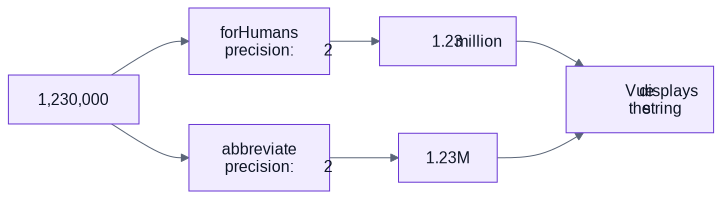
Number::forHumans(1_230_000, precision: 2)is1.23 million.Number::abbreviate(...)with the same arguments is1.23M.abbreviate()is justforHumans()withabbreviate: true.- The default precision is 0, so
Number::forHumans(1500)is2 thousandandNumber::abbreviate(1500)is2K. Passprecision: 1when you want1.5 thousand. - Both helpers go through
Number::format(), so they need theintlPHP extension. A plain0is the exception: it returns"0"without callingformat(). - Unit words stay in English even when the locale changes the digits.
Number::withLocale('de', fn () => Number::forHumans(1_230_000, precision: 2))is1,23 million, not a German word for million.
What Number::forHumans() is, and why people miss it#
Number::forHumans() takes a number and returns a string you can put on a dashboard: thousands, millions, billions, trillions, quadrillions. Number::abbreviate() does the same job with short suffixes: K, M, B, T, Q.
The official docs use the same three values for both:
use Illuminate\Support\Number;

Number::forHumans(1000);
// 1 thousand

Number::forHumans(489939);
// 490 thousand

Number::forHumans(1_230_000, precision: 2);
// 1.23 million

Number::abbreviate(1000);
// 1K

Number::abbreviate(489939);
// 490K

Number::abbreviate(1_230_000, precision: 2);
// 1.23M
forHumans() arrived with the Number class in Laravel 10.33.0 on 21 November 2023 (PR #48845). abbreviate() followed two weeks later in 10.35.0, on 5 December 2023 (PR #49197). Every 11.x, 12.x and 13.x app already has both. People miss them because the need shows up as “make this count shorter” and the habit is a divider in Vue or a 10-line PHP helper, and because the docs file them under the long helpers list, among clamp(), currency() and fileSize().
abbreviate() is not a separate formatter. It calls forHumans(..., abbreviate: true) and swaps the suffixes. In the lab, Number::abbreviate(1_230_000, precision: 2) and Number::forHumans(1_230_000, precision: 2, abbreviate: true) were the same string.
The usual way vs Number::abbreviate()#
The helper below is what we had in the lab before switching. It is fine for 1,230,000. It is also how 999,500 becomes 1000K:
A divide-by-1,000 helper, then Number::abbreviate() / forHumans():
function compactCount(int|float $n): string
{
    if ($n >= 1_000_000) {
        return round($n / 1_000_000, 2).'M';
    }

    if ($n >= 1_000) {
        return round($n / 1_000).'K';
    }

    return (string) $n;
}

compactCount(1_230_000); // 1.23M
compactCount(1_500);     // 2K
compactCount(999_500); // 1000Kuse Illuminate\Support\Number;
Number::abbreviate(1_230_000, precision: 2); // 1.23M
Number::abbreviate(1_500, precision: 1); // 1.5K
Number::abbreviate(999_500); // 1M
Number::forHumans(1_230_000, precision: 2); // 1.23 million
Number::forHumans(1_500, precision: 1); // 1.5 thousand
Number::forHumans(999_500); // 1 millionIn the lab, values under 1,000 stayed as themselves: 42, 500, 999. 12,345 became 12 thousand, or 12.345 thousand with precision: 3. 1,500,000,000 with the default precision became 2 billion.
The rollover matters. 999,500 rounds to 1,000 thousands, and a current Laravel release steps up a unit: 1 million / 1M, not 1,000 thousand. That fix shipped in Laravel 13.6.0 (PR #59692, 21 April 2026). With precision: 1, the same number stays 999.5 thousand, because the formatted value has not reached 1,000 yet.
Precision is the whole trick#
The default precision is 0. That is why Number::forHumans(1500) is 2 thousand and Number::abbreviate(1500) is 2K. 1,499 goes the other way: 1 thousand / 1K. Pass precision: 1 and both 1,500 and 1,499 become 1.5 thousand.
maxPrecision is the sibling of precision. precision: 2 always prints two decimal places; maxPrecision: 2 prints at most two and drops trailing zeros. In the lab, Number::forHumans(1_000_000, precision: 2) was 1.00 million, and Number::forHumans(1_000_000, maxPrecision: 2) was 1 million. For 1,234,567 both options returned 1.23 million.
If you are putting these strings on a dashboard, start with precision: 1 or precision: 2. The default is for when a rounded whole unit is what you actually want.
Real-world example: a Vue + Inertia dashboard#
Format the counts in the controller (or a resource, or shared Inertia props) and let Vue print the strings. Do not send 1,230,000 and hope every page agrees on rounding:
use Illuminate\Support\Number;
use Inertia\Inertia;
use Inertia\Response;

class DashboardController
{
    public function __invoke(): Response
    {
        $users = 1_230_000;
        $views = 1_500;

        return Inertia::render('Dashboard', [
            'stats' => [
                'users' => Number::forHumans($users, precision: 2),
                'usersShort' => Number::abbreviate($users, precision: 2),
                'views' => Number::forHumans($views, precision: 1),
            ],
        ]);
    }
}<script setup lang="ts">
defineProps<{
stats: {
users: string
usersShort: string
views: string
}
}>()
</script>
<template>
<section>
<p>{{ stats.users }} users</p>
<p>{{ stats.views }} views this week</p>
</section>
</template>We exposed the same values from a lab route. The JSON was 1.23 million, 1.23M, 1.5 thousand, and 1M for a 999,500 error count with the default precision. Vue does not need a compact-number filter.
Gotchas#
Gotcha: Default precision is 0, so 1,500 becomes 2 thousand
Number::forHumans(1500) is 2 thousand. Number::abbreviate(1500) is 2K. That is rounding, not a bug: 1.5 thousands, at precision 0, is 2. Pass precision: 1 when the half matters.
Other traps we hit:
- Both helpers need the
intlPHP extension, because they format the significand withNumber::format(). Ifintlis missing, you getRuntimeException: The "intl" PHP extension is required to use the [format] method.The message saysformateven when you calledforHumans()orabbreviate(). A plain0is the odd one out: with precision 0 it returns"0"without going throughformat(), so it can hide a missing extension in a thin test. Number::withLocale('de', ...)changes the digits, not the words.1.23 millionbecomes1,23 million. The unit names (thousand,million,billion,trillion,quadrillion) and the abbreviations (K,M,B,T,Q) stay as they are.withLocale()does not persist.Number::useLocale('de')does, until you set it back.- Named units stop at a quadrillion (
Q). A quintillion stacks the last unit:Number::abbreviate(1e18)is1KQ, andNumber::forHumans(1e18)is1 thousand quadrillion.1e21is1MQ. If you ever format numbers that large, do not use these helpers. - Older 13.x releases had a few sharp edges that 13.20 and later already fix. Before 13.6.0,
999,500could render as1,000 thousand/1,000K(PR #59692). Before 13.18.0,INFand-INFcould recurse until PHP ran out of memory (PR #60617); they now return∞and-∞, andNANreturnsNaN. Before 13.20.0,Number::forHumans(-0.4)was-0(PR #60736) andNumber::forHumans(0.005)was5(PR #60768). In 13.42 both are0, andNumber::forHumans(-0.4, precision: 2)is-0.40.
Try it yourself#
Format a million, then hit the precision trap
php artisan tinkeruse Illuminate\Support\Number;
Number::forHumans(1_230_000, precision: 2); // "1.23 million"
Number::abbreviate(1_230_000, precision: 2); // "1.23M"
Number::forHumans(1500); // "2 thousand"
Number::forHumans(1500, precision: 1); // "1.5 thousand"
Number::abbreviate(999_500); // "1M"How useful is this?#
| Score | |
|---|---|
| Time saved per use | ★★★★☆ One call replaces a divider helper that is easy to get wrong at unit boundaries |
| How often you’ll reach for it | ★★★★☆ Dashboards, admin totals, Inertia shared props, any count a human should read at a glance |
| Risk if misused | ★★☆☆☆ Default precision surprises; a missing intl extension throws; unit words are not translated |
| Overall | 4 / 5: the clean way to format counts on the server before Vue sees them |
Recap#
Number::forHumans()writes1.23 million.Number::abbreviate()writes1.23M. They share one implementation.- Pass
precision(ormaxPrecision) for dashboards. The default of 0 turns 1,500 into2 thousand. 999,500rolls over to1 million/1Mon Laravel 13.6 and later.- Install
intl. Customize digits withwithLocale(); the words stay in English.
FAQ#
Which Laravel version added Number::forHumans() and Number::abbreviate()?
forHumans() shipped with the Number class in Laravel 10.33.0, on 21 November 2023 (PR #48845). abbreviate() followed in 10.35.0, on 5 December 2023 (PR #49197). Both are in every later 11.x, 12.x and 13.x release. Use 13.20 or later if you want the rollover, INF and tiny-value fixes.
What is the difference between forHumans() and abbreviate()?
Only the suffixes. forHumans() uses thousand, million, billion, trillion and quadrillion. abbreviate() uses K, M, B, T and Q. abbreviate() calls forHumans() with abbreviate: true.
Why is Number::forHumans(1500) "2 thousand"?
The default precision is 0, so 1.5 thousands rounds to 2. Pass precision: 1 to get 1.5 thousand, or precision: 2 if you want a fixed two decimal places.
Do I need the intl PHP extension?
Yes, for any value other than a plain zero at precision 0. The exception mentions the format method even when you called forHumans() or abbreviate(), because that is the method that talks to NumberFormatter.
Can I localize the words thousand and million?
Not through these helpers. withLocale() and useLocale() only change how the digits are formatted (1.23 vs 1,23). The unit words and K/M/B/T/Q suffixes stay as written. For translated unit names, you would need your own map.
Next steps#
- Run independent dashboard queries in parallel, then format the totals with
Number::forHumans() - Http::pool() for concurrent requests, when the counts come from several HTTP services
- Laravel docs: Number::forHumans() and Number::abbreviate()
Sources#
- Laravel docs: Number::forHumans()
- Laravel docs: Number::abbreviate()
- PR #48845: Add a Number utility class (Laravel 10.33.0, 21 November 2023)
- PR #49197: Add support for Number::summarize (Laravel 10.35.0, 5 December 2023)
- PR #59692: Fix number abbreviation rollover between unit tiers (Laravel 13.6.0, 21 April 2026)
- PR #60617: Fix Number::forHumans() and Number::abbreviate() crashing on INF/NAN (Laravel 13.18.0, 30 June 2026)
- PR #60736: Fix Number::forHumans() and abbreviate() returning “-0” (Laravel 13.20.0, 14 July 2026)
- PR #60768: Fix Number::forHumans() and abbreviate() scaling tiny decimals (Laravel 13.20.0, 14 July 2026)
- Source:
Illuminate\Support\Number