You send a download link that should die in 15 minutes. On Laravel 13.40, one extra positional parameter could keep it alive forever. Laravel 13.41 fixes that and a nested validation bypass, and adds $request->uuid(), $request->ulid(), Uri::origin() and a MigrationFailed event. Install it this week.
TL;DR
- 13.41.0 was tagged on November 10, 2026 (15:44 UTC). 13.42.0 followed 12 minutes later with only a version bump, so
composer updatelands you on 13.42.0 with the same code. - Security: on 13.40, a positional parameter like
'expires='inURL::temporarySignedRoute()produced a valid link that never expired. A nestedsometimesrule also skipped any value that was literally"__missing__". Both are fixed, and backported to 12.72.0. Links already sent stay valid after the upgrade, so add the small check below. $request->uuid('order_id')and$request->ulid('invoice')return real ID objects (ornull), likedate()andenum().MigrationFailedfires when a migration throws, andScheduledTaskSkippednow tells you why a task was skipped.
What’s new at a glance#
| Change | PR | What it replaces |
|---|---|---|
| Positional route parameters URL-encoded (security) | port of #62401 | Raw &expires= that cancelled the expiry |
sometimes on nested keys checks "__missing__" (security) | port of #62402 | A magic string that skipped validation |
expires read from the raw query string as a fallback | port of #62349, #62391 | Signed links failing when the query bag is empty |
uuid() and ulid() on InteractsWithData | #62327, #62348 | Uuid::fromString($request->input(...)) plus a null check |
Uri::origin() | #62326 | parse_url() and string glue |
MigrationFailed event | #62342 | Catching the exception in your deploy script |
ScheduledTaskSkipped::$reason | #62294 | Guessing why a task didn’t run |
LostConnectionDetector::detectUsing() | #62316 | Binding a decorated detector |
PendingProcess is macroable | #62351 | Macros that only worked as the first call |
schedule:list --json keeps each task’s timezone | #62352 | Expressions that drift an hour after DST |
foreignIdFor() with $keyType = 'integer' | #62365 | A char(36) column for a bigint key |
TokenGuard::validate() hashes the token | #62336 | validate() always false with 'hash' => true |
preventLazyLoading() works with cursor() | #62345 | Silent N+1 inside cursor() loops |
| JSON sessions survive invalid UTF-8 | #62378 | Users signed out by one bad byte |
Lost connection on COMMIT drops the PDO | #62366 | A worker stuck on “already an active transaction” |
Signed links that never expired#
URL::temporarySignedRoute() accepts a parameters array. Named keys fill route segments or become key=value pairs. Values with integer keys that don’t match a segment were appended to the query string as they were, with no encoding.
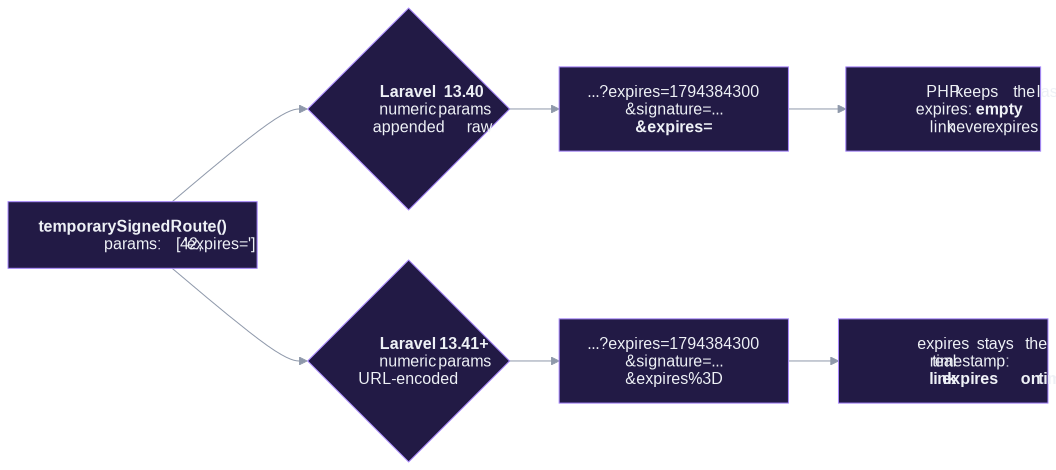
So if one of those values was expires=, the URL ended in &expires=. The signature covered it, PHP kept the last expires (an empty string), and Laravel’s expiry check treats an empty expires as “no expiry”. Here is the same call on both versions from our lab:
Laravel 13.40, then Laravel 13.41+:
$url = URL::temporarySignedRoute(
    'exports.download',
    now()->plus(minutes: 5),
    [42, 'expires='],
);

// /exports/42?expires=1794384300&signature=...&expires=
// request()->query('expires') === ''
// One year later: URL::hasValidSignature($request) === true$url = URL::temporarySignedRoute(
'exports.download',
now()->plus(minutes: 5),
[42, 'expires='],
);
// /exports/42?expires=1794384300&signature=...&expires%3D
// request()->query('expires') === '1794384300'
// Six minutes later: URL::hasValidSignature($request) === false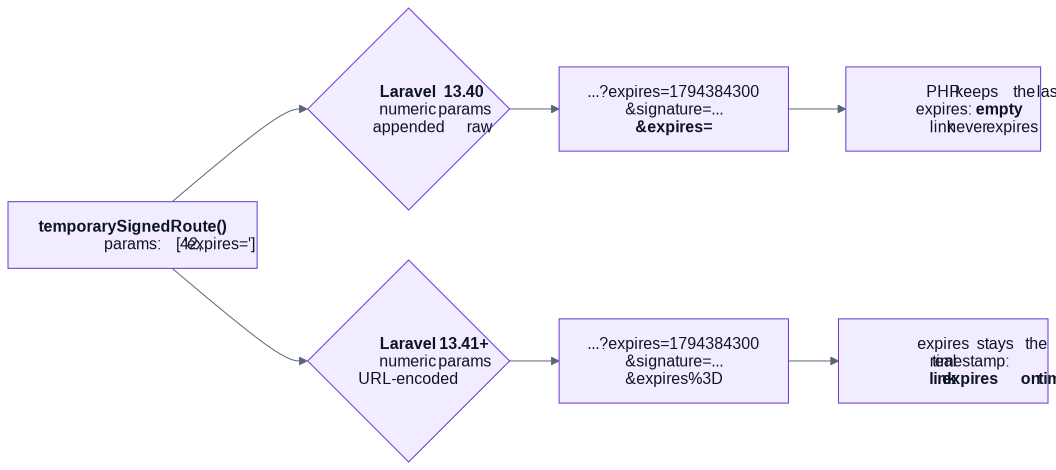
You are exposed if any value with an integer key in that array can come from a user: a reference, a filename, a “return to” value. Named keys were always encoded, so ['export' => 42, 'ref' => $ref] was safe.
13.41 also reads expires from the raw QUERY_STRING (or Vapor’s VAPOR_RAW_QUERY_STRING) when the parsed query has none, and rejects it if it arrives as an array.
Heads up: Upgrading does not kill links already sent
We fed a link generated on 13.40 into 13.42 and moved the clock a year ahead: still valid. The URL itself carries the empty expires, and rotating APP_KEY won’t help if the old key sits in APP_PREVIOUS_KEYS, because signed URLs accept previous keys too. If you could have sent such links, reject an empty expires before the signed middleware runs (below). A real signed link never has one.
namespace App\Http\Middleware;

use Closure;
use Illuminate\Http\Request;
use Symfony\Component\HttpFoundation\Response;

class RejectEmptySignedExpiry
{
    public function handle(Request $request, Closure $next): Response
    {
        if ($request->query->has('signature') && $request->query('expires') === '') {
            abort(403, 'Invalid signature.');
        }

        return $next($request);
    }
}Route::get('/exports/{export}', DownloadExportController::class)
->middleware([RejectEmptySignedExpiry::class, 'signed'])
->name('exports.download');The __missing__ validation bypass#
Laravel’s validator used the string "__missing__" internally to mean “this nested key isn’t there”. If a client sent that exact string as a nested value, sometimes thought the field was absent and skipped every rule on it. Top-level fields were not affected.
$v = Validator::make(
    ['profile' => ['age' => '__missing__'], 'items' => [['qty' => '__missing__']]],
    ['profile.age' => 'sometimes|integer', 'items.*.qty' => 'sometimes|integer'],
);

// 13.40: passes, and validated() returns both "__missing__" strings
// 13.41: fails on profile.age and items.0.qty
The fix swaps the magic string for a private UndefinedValue object, so no request payload can collide with it. If you have sometimes on nested or wildcard keys and then trust validated(), this one matters.
Read UUIDs and ULIDs straight from the request#
uuid() and ulid() join date(), enum() and friends on InteractsWithData. That covers Request, $request->safe(), Fluent, UriQueryString, Blade component attributes and console input.
Laravel 13.40, then Laravel 13.41:
use Ramsey\Uuid\Uuid;

public function show(Request $request)
{
    $orderId = $request->filled('order_id')
        ? Uuid::fromString($request->input('order_id'))
        : null;

    // ...
}public function show(Request $request)
{
$orderId = $request->uuid('order_id'); // UuidInterface|null
$invoice = $request->ulid('invoice'); // Symfony\Component\Uid\Ulid|null
// ...
}Missing or empty input returns null. Invalid input throws: InvalidUuidStringException for uuid() and InvalidArgumentException for ulid(). Validate first ('order_id' => 'nullable|uuid'), then read it from $request->safe()->uuid('order_id') so a bad value turns into a 422 and not a 500.
Gotcha: ulid() won't convert a UUID
ulid() uses new Ulid($value), not Ulid::fromString(). Passing a UUID string throws instead of silently turning it into a different ULID. Our lab confirmed it.
Uri::origin() for CORS and same-origin checks#
Uri::origin() returns the scheme, host and port, normalised. Default ports disappear and the host is lowercased, so two spellings of the same origin compare equal.
use Illuminate\Support\Uri;

Uri::of('https://App.Example.com:443/billing?tab=1#top')->origin(); // "https://app.example.com"
Uri::of('http://localhost:8000/dashboard')->origin();               // "http://localhost:8000"

$allowed = collect(config('services.embed.origins'))
    ->map(fn (string $url) => Uri::of($url)->origin());

$isAllowed = $allowed->contains(Uri::of($request->headers->get('origin', ''))->origin());
It needs league/uri 7.6 or later, which 13.41 requires, so composer update takes care of it.
Get told when a migration fails#
MigrationFailed fires when a migration throws, then the exception is rethrown as before. It carries the migration, the method (up or down), the migration name and the exception. On MySQL, DDL can’t be rolled back, so half a migration may already be applied when this fires.
use Illuminate\Database\Events\MigrationFailed;
use Illuminate\Support\Facades\Event;
use Illuminate\Support\Facades\Log;

public function boot(): void
{
    Event::listen(function (MigrationFailed $event) {
        Log::channel('slack')->critical("Migration {$event->name} failed during {$event->method}", [
            'error' => $event->exception->getMessage(),
        ]);
    });
}
In our lab a migration that threw column already exists fired the event with name 2026_11_11_000000_broken and method up, and php artisan migrate still failed with the original exception.
Find out why a scheduled task was skipped#
ScheduledTaskSkipped (which 13.40 started firing for onOneServer()) now has a $reason: a ScheduledTaskSkipReason enum with ConditionNotMet, Paused and RanOnAnotherServer.
use Illuminate\Console\Events\ScheduledTaskSkipped;

Event::listen(function (ScheduledTaskSkipped $event) {
    Log::info('Scheduled task skipped', [
        'task' => $event->task->getSummaryForDisplay(),
        'reason' => $event->reason?->value, // condition_not_met | paused | ran_on_another_server
    ]);
});
Related: schedule:list --json now returns each task’s own expression and timezone instead of converting everything to the app timezone. A 0 9 * * * task in Europe/Zurich used to come back as 0 8 * * * UTC, which is wrong for half the year. Pass --timezone if you still want the converted version.
Smaller additions you’ll use#
Teach Laravel a new “lost connection” message. Behind Vitess, PgBouncer or a cloud proxy you see errors Laravel doesn’t recognise, so it won’t reconnect. Now it’s one line:
use Illuminate\Database\LostConnectionDetector;

LostConnectionDetector::detectUsing(
    fn (Throwable $e) => str_contains($e->getMessage(), 'vttablet: rpc error'),
);
Macros anywhere in a process chain. PendingProcess is now Macroable, so a macro works after path() or tty(), not only as the first call:
use Illuminate\Process\PendingProcess;

PendingProcess::macro('withAppEnv', fn (string $env) => $this->env(['APP_ENV' => $env]));

Process::path(base_path())->withAppEnv('staging')->run('php artisan about');
foreignIdFor() and $keyType = 'integer'. The rest of Eloquent treats int and integer the same, but foreignIdFor() only knew int and created a UUID (char(36)) column. It now creates a big integer column.
Fixes that might already be biting you#
- Hashed API tokens: with
'hash' => trueon thetokenguard,Auth::guard('api')->validate([...])always returnedfalsebecause it skipped the hash. Fixed (#62336). cursor()and lazy loading:Model::preventLazyLoading()was ignored for models streamed withcursor(). It now throwsLazyLoadingViolationException, so an N+1 hidden in an export loop will show up in tests (#62345).- JSON sessions: new apps ship with
'serialization' => 'json'. One invalid UTF-8 byte (a malformedReferersaved asurl.intended, say) madejson_encode()fail and emptied the whole session, signing the user out. The bad byte is now replaced with U+FFFD (#62378). - Lost connection on commit: on PostgreSQL, a connection dropped during
COMMITleft every later transaction failing with “There is already an active transaction” until the worker restarted. Laravel now drops the dead PDO and reconnects (#62366). - Also:
dispatch()->afterResponse()reports exceptions instead of trying to render them (#62313), Pusher auth returns 403 for an arraychannel_nameinstead of a 500 (#62309), and the Ably broadcaster supportsably/pubsub-server2 (#62315, #62322).
Upgrade notes#
composer update laravel/frameworkputs you on 13.42.0 (same code as 13.41.0). No config to publish.- Extra positional route parameters are now URL-encoded.
route('search', ['q' => 'a', 'raw&x=1'])used to appendraw&x=1as two params. If you relied on that, pass named keys instead. - Code that lazy loads inside
cursor()loops may now throw wherepreventLazyLoading()is on (usually only outside production). Addwith()or turn the loop intolazy()with eager loads. - If you parse
schedule:list --json, expressions now come in each task’s own timezone. - On Laravel 12? 12.72.0 (November 10) backports the signed URL fix, the nested
sometimesfix, theexpiresfallback and theschedule:list --jsonchange. It also rejects email addresses longer than 254 characters (RFC 5321), which 13.x hasn’t picked up yet. The new features above are 13.x only.
Prove your signed links expire
use Illuminate\Http\Request;
use Illuminate\Support\Facades\URL;

it('expires signed export links even with positional params', function () {
    // assumes a route named exports.download with an {export} segment
    $url = URL::temporarySignedRoute('exports.download', now()->plus(minutes: 5), [42, 'expires=']);

    expect(URL::hasValidSignature(Request::create($url)))->toBeTrue();

    $this->travel(6)->minutes();

    expect(URL::hasValidSignature(Request::create($url)))->toBeFalse();
});
Also out this week#
Laravel AI SDK 1.4 (November 10) exposes the raw HTTP response on classification, embeddings, transcription, image and reranking responses, lets agents recover when a tool throws, and lets agent fakes resume tool approvals in tests. We’ll cover it in Monday’s roundup. Reverb 1.13 is maintenance (Guzzle 8 support, PHPStan 2) plus a fix that scopes client event membership checks to the connection’s app.
Recap#
- Upgrade now if you send signed links or validate nested input: both bypasses are fixed in 13.41 and 12.72. Reject an empty
expiresto retire links already sent. $request->uuid()/ulid()return ID objects ornull, and throw on junk, so validate first.Uri::origin()gives you a normalised origin for CORS lists and same-origin checks.MigrationFailedandScheduledTaskSkipped::$reasonmake deploys and the scheduler easier to watch.- Several quiet fixes: hashed
TokenGuard::validate(),cursor()lazy loading, JSON sessions and lost connections on commit.
FAQ#
Should I install 13.41 or 13.42?
Run composer update laravel/framework and you get 13.42.0. Its only change from 13.41.0 is the version number.
Am I affected by the signed URL bug?
Only if you pass values with integer keys to URL::temporarySignedRoute() (or signedRoute() with an expiration) and one of them can come from a user. Named parameters were always encoded.
Do I need to change code for the validation fix?
No. If you use sometimes on nested or wildcard keys, a literal "__missing__" value is now validated like any other string. Nothing changes for real input.
What does $request->uuid() return for an invalid value?
It throws InvalidUuidStringException. Missing or empty input returns null. Validate with the uuid rule first if the value comes from users.
Is any of this in Laravel 12?
The security fixes are, in 12.72.0, along with the schedule:list --json change. uuid(), ulid(), Uri::origin(), MigrationFailed and the other features are 13.x only.
Next steps#
- Laravel 13.40: slow job alerts, middleware insertBefore() and strict input
- Laravel signed URLs with Vue: email links, invites and private downloads
- Laravel 13.36: validation rule builders, OLAP and sticky queues
- URL generation in the Laravel docs
Sources#
- laravel/framework v13.42.0 release and v13.40.0…v13.41.0 compare
- laravel/framework v12.72.0 release notes
- 13.x ports of the security fixes: ba9e21e and aa9deaa
- PRs: #62401, #62402, #62349, #62391, #62327, #62348, #62326, #62342, #62294, #62352, #62316, #62351, #62365, #62336, #62345, #62378, #62366
- Docs: Retrieving input (uuid / ulid)
- laravel/ai v1.4.0 · laravel/reverb v1.13.0